Police as crisis interventionist: CIT as it is meant to be

San Antonio, TX  – February 25, 2017 Police officers wear many hats these days.  I have spent the last few days learning about a specialized police unit in San Antonio Texas with the SAPD. The Mental Health Unit is a small, well-trained group of police officers who have committed themselves to the positive interaction of police officers and citizens with presumed mental illness. These police officers have a unique window into the chaos some families experience and the opportunity to bring calm to crisis (Sefton, 2014). In many cases, the correct response to this dysfunction should include a follow-up visit in the aftermath of the initial call when the dust has settled from the crisis that brought police to this threshold.  When this is done it establishes a baseline of trust, empathy, and resilience. It works and I have seen it for myself.

Over a 15 year span the SAPD has established relationships and built a continuum of service whose mission is jail diversion and treatment for those who are afflicted with mental illness and substance abuse.  The Restoration Center  in downtown San Antonio is the nucleus for this “smart justice” model. It includes a mobile crisis outreach, 48 hour hospitalization, if necessary, a 90-day homeless shelter with job training e.g. resume building and job interview clothing, childcare and apartment units for those who qualify.  As subjects move through the continuum they are provided referrals for individual psychotherapy, substance abuse education, Alcoholic’s Anonymous and the range of 12-step recovery programs.  And everyone working there buys in.

Police are the front line responders to crises of all kinds. Asking them to serve in this new role presents a level of officer specialization like never before.  Michael Sefton blog post 2013

mental-health-squad
SAPD Officer Ernest Stevens PHOTO Jenny Snow Kaiser Health News

I was given the complete tour and introduced to some key players including Ms. Amanda Miller coordinator at the Mobile Outreach program.  The experience was enriching and illustrated the range of possibilities of humane care for those most vulnerable and often incompetent to make healthy choices for themselves.  I wasn’t sure what to expect but I came away wishing I could have stayed on longer. The project diverts citizens into treatment in lieu of incarceration and also serves as an in-house resource where brother officers can turn when times get tough. And the mental health unit has seen its share of despair and self-destruction on their side of the blue line with sometimes insufferable results.

Police officers’ department-wide are trained in techniques of crisis intervention by the same two officers I was fortunate enough to ride with. For years, too many emotionally troubled citizens wound up among the incarcerated criminal population in state and county jails and did not receive the care they needed. In Bexar County, Texas, which includes San Antonio, with a growing population of over 1.5 million the main jail now has 800 open beds where it was once filled to capacity.

“CIT provides police with all kinds of useful resources. And when combined with adaptive strategic thinking, access to mental health professionals, and good leadership and good culture around applying the lessons of CIT, it can save lives,” said David M. Perry, an associate professor of history at Dominican University in Illinois and a journalist who has written about police violence and disabilities recently cite in a CNN story written by Liza Lucas in 2016.

San Antonio and over 22 communities share the services of the Restoration Center in downtown San Antonio


Culpability and Mental Illness

Are those with mental illness culpable for their behavior? Technically they are responsible unless determined to be unable to discern right from wrong based upon their mental incapacity. Does the fact that they suffer with conditions like bipolar depression, schizophrenia, or drug addiction render them not responsible?  There is a national trend to view those with active mental illness as “not responsible” for their behavior largely due to the common belief that if the mental illness were being treated than the criminality in which they may be embroiled would plausibly diminish. Whenever something sensational happens like a school shooting or some other senseless criminal act people universally remark “he was sick” or “she must have been out of her mind” to do that.  Not so fast say the social scientists where as the true prevalence of diminished capacity is quite rare.

I strongly believe that mental illness does not exempt citizens from responsibility for crimes they commit. I agree that alternative sentencing may be a powerful tool to bring these individuals into treatment. The substantive goal of streamlining encounters between police officers and citizens who suffer with untreated emotional problems belies the mission of these gifted officers and can teach others the role of discretion in mental health encounters. The reason for this is to deescalate potential violence and thereby reduce the incidence mentally disturbed persons who wind up in jail.  This speaks to the importance of getting those most in need into treatment and off the streets sometimes by having a judge mandate they enter treatment. When charges are brought forth alternative sentencing models may offer leverage that include mandated treatment in lieu of jail time know as alternative sentencing. Studies show that those who remain in treatment are less violent than those who fail or drop out of treatment, Torrey, et.al., 2008. In Massachusetts where I served as a police officer for 12 years too many myths entangled the process of accessing treatment for the mentally ill.  Officers were sometimes unsure of their options when a Q-5 prisoner was brought it and rarely made referrals for mental health care.  Q-5 is the nomenclature used when referring to someone with a history of mental health issues – usually suicidal threats. These prisoners were required to be on one to one supervision when held in jail. At least that was the myth at the time I was serving.

Community Policing and Aftermath Intervention

img_6995
Michael Sefton with SAPD-  officers Ernest Stevens (center) and Joseph Smarro (right)

I learned several important things about police officer interaction with citizens having mental illness.  It is a complex and time consuming endeavor that requires follow up in the aftermath of a crisis.  Police officers build credibility and trust in the process of this community interaction with citizens and those in the treatment continuum like physician Roberto Jimenez, M.D., a psychiatrist who has been there from the beginning in Bexar County. Dr. Jiminez began his career in Boston at the once revered Boston City Hospital where I completed my postdoctoral fellowship. He said to me “we had the national model in Boston….” referring to the system in place for police-mental health interaction in 1980. At the time, his service was utilized in conjunction with the state department of mental health and an active system of neighborhood health centers throughout the city. He referred to himself as the police psychiatrist.  By then, the Massachusetts state hospital system had been deconstructed and was no longer in the continuum of care. The chronically ill fell off the treatment radar.  Importantly in Massachusetts, this triggered the swing away from hospital-based care to the community health centers who became the front line for those in crisis.  At this point the myth of mental illness began its insidious transformation. Jail became the containment locale in the absence of the venerable state hospitals for better or for worse. In January 2017, Massachusetts Governor Charlie Baker expanded number of available beds at the Bridgewater State Hospital for care of those in crisis.

Officers in the SAPD Mental Health Unit undergo specialized training in crisis intervention. Officers Stevens and Smarro teach the 40-hours class to police officers from across the country. All police recruits in the SAPD academy are given this training as part of their early law enforcement education suggesting strong support from the command hierarchy. Importantly, the CIT model teaches officers to return to the scene of their calls to make referrals for care as I observed in February.  The follow-up call is key in rebuilding trust and illustrates the commitment in police-mental health care continuum. Just as importantly is the relationship created among police officers and direct service personnel like Dr. Jimenez who share the understanding of what can be done for those most in need.

Ostensibly, building relationships with network psychotherapists, physicians, addiction specialists, court judges, and other support service like Child and Family Services is essential.  Officers Stevens and Smarro spent hours on the telephone reaching out to the network of physicians, judges, hospital admission personnel and brother officers all in the service of a single case they picked up one evening while on an overtime patrol shift. Had they not caught the call on that night the complainant family may have flown under the law enforcement radar forever and a 33-year old depressed and delusional male may have become increasingly morose perhaps violent.  Instead he was put into treatment with the real eventual possibility of receiving social security disability payments to help he and his family and the treatment he needs to begin life again. Next is a strong conviction in what you are being asked to do. It is necessary and constitutive work that often flies below the radar and out of the headlines. It requires patience, flexibility and the right temperament.  And finally, officers need to follow-up on calls and build bridges and trust with those they serve including members on the same side of the thin blue line.

Setting the San Antonio program apart is the routine followup in the aftermath of high intensity calls such as domestic conflict or the run-of-the mill calls to houses where families are struggling with under employment, substance use or any number of social problems.  A brief second or third visit may just do the trick to hook in a family or individual otherwise in the margins of society bringing forth growth and human contact.


REFERENCES

Perry, D.  2016. Changing the way police respond to mental illness. http://www.cnn.com/2015/07/06/health/police-mental-health-training/

Sefton, M. 2014 Aftermath Intervention: Police first to the threshold. https://wordpress.com/post/msefton.wordpress.com/599

Sefton, M. 2017 Police as therapist: the inherent risk of unconditional positive regard. Blog post. https://msefton.wordpress.com/2017/01/16/

Torrey, CF et. al. 2008. The MacArthur violence risk assessment study revisited: Two views ten years after its initial publication. Psychiatric Services, vol. 59, issue 2, February 2008, pp. 147-152.

Police as therapist: the inherent risk of unconditional positive regard 

WESTBOROUGH, MA January 12, 2017 Changes in the responsibility for those afflicted with major mental illness must remain in the hands of medical and psychiatric providers who are trained in contemporary diagnosis and treatment models. Yet a growing mental health strategy has emerged to train and educate first responders – including the police to deescalate and divert those with mental illness from jails into treatment.  The problem with diversion here in Massachusetts and New England is that a continuum of care is lacking. Since the closure of the state hospital system here in Massachusetts the community-based treatment centers have been overwhelmed by the volume of cases they must see.  To say they have failed is shortsighted and disingenuous and behalf of the Globe Spotlight team.

Make no mistake about it, putting police officers in the place of psychotherapists and psychiatrists is not going to happen here or anywhere. But cops are being asked to act as mediators to diffuse encounters with persons with suspected mental illness. The intention is to reduce violent encounters between the police and those with mental health issues. “Most people with mental illness are not dangerous, and most dangerous people are not mentally ill” according to Liza Gold, 2013. Yet in the past several years there have been many high profile officer-involved shootings involving people afflicted with a variety of psychiatric conditions including major depression raising the specter of suicide by cop.

POLICE ACT AS CRISIS MEDIATORS WITH MENTALLY ILL

It is very risky putting the police in the role of crisis intervention specialists to manage those who may be emotionally distraught. For one thing the high incidence of drug and alcohol intoxication in these cases makes any negotiation or mediation almost impossible. I was always taught that until the patient is sober there is no meaningful assessment or interaction is possible.  Police are the front line responders to crises of all kinds. Asking them to serve in this new role presents a level of officer specialization like never before.  Some officers are being asked to offer unconditional positive regard to those encounters in an effort to slow the scene giving time for intervention to take hold.  In some places like San Antonio, TX and Vancouver, BC it works.  But it has taken a long time to gain traction. If the goal is to avoid incarcerating those with mental illness this is especially difficulty in the absence of a treatment continuum as I have said.  In the cities just mentioned there is a well established mental health infrastructure that affords the police various options for the unstable citizens they are asked to assist.

In most larger communities a dearth of mental health services exist resulting in a large number of mentally ill persons being held in custody – sometimes a county house of correction or any one of

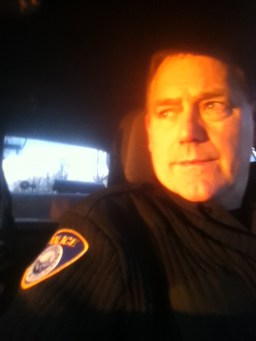
Dr. Michael Sefton brought out myths of mental illness while serving as a police officer retiring in 2015

16 prisons in the Commonwealth of  Massachusetts. The Spotlight team at the Boston Globe has featured the plight of those who are sent to prison with comorbid mental illness and substance abuse. The fact is that criminality and mental health are often difficult to disentangle.

The National Alliance for the Mentally Ill believe as many as 20 to 40 percent of prison inmates may have severe mental illness and may not be receiving the needed treatment to allow them to rehabilitate.  Yet in the absence of the mental health infrastructure needed to provide treatment – including hospital care for those most unstable, few viable options were put forth.

The Boston Globe fails to inform readers that criminality and mental illness are not mutually exclusive.  Drug addicts break into homes to feed the hunger of their addiction.  In prototypic fashion, the Globe offers no alternative and no solution aside from casting blame on the Commonwealth of Massachusetts. Without a doubt the stories they report are heart wrenching and emotionally palpable for the readers. But not all those in custody who are suspected of preexisting mental illness are helplessly suffering without therapy.  Most are not.  In many cases being incarcerated allows an addict to become clean and sober and begin the first steps of recovery. Those who are most resistant to therapy and fail to attend psychotherapy, anger management, and medication monitoring have a higher risk of violence and substance abuse. This fact must be considered when responsibility for treatment failure is studied.  

Those relationships that suppress the normal, effusive, life force are detrimental to health much like a toxin said Sefton in 2013.

ALTERNATIVE SENTENCING

With so many incarcerated persons with suspected mental illness change must be initiated  by having services available to those on the front lines.  The criminal justice system and the department of mental health have an opportunity to work together now that the pendulum once again swings toward a treatment model. The police can be trained to control the scene through intervention and mediation strategies by slowing things down. When charges are brought alternative sentencing models may offer leverage that include mandated treatment in lieu of jail time.  Studies show that those who remain in treatment are less violent than those who fail or drop out of treatment, Torrey, et.al., 2008.

Mental health patient often rely on community services and social welfare including housing, disability payments, medical care and more.  Access to these services may be tied to participation in treatment including psychotherapy, medication, if prescribed, and substance abuse treatment.  Here is Massachusetts M.H. Advocates reject this notion as unfair a response that remains unique across the country.

The interaction of substance abuse and mental illness is complex.  Persons with drug and alcohol addiction must be expected to become sober with the help of substance abuse treatment and family support. The risk of violence and suicide declines when sobriety can be maintained.  The 12-step programs have great success and are free to anyone willing to attend. Family members may attend Al-Anon or some drug-specific family support group.

Mental health infrastructure is necessary for the system to work.  In San Antonio it has taken 15 years to establish a system that works and saves lives.


Torrey, CF et. al. The MacArthur violence risk assessment study revisited: Two views ten years after its initial publication. Psychiatric Services, vol. 59, issue 2, February 2008, pp. 147-152.

New age cops – the future innovation of community policing

WESTBOROUGH, MA December 29, 2016 I have long been an advocate for prompt and comprehensive treatment for those afflicted with mental illness.  Now police are increasingly linking up with mental health agencies as a way of diverting mentally ill person’s from jails into treatment for their emotional affliction.  In my experience this is no easy task.  In some cases criminality and mental illness are not mutually exclusive.  Some who suffer with emotional issues like bipolar depression, drug addiction or anxiety may respond poorly to treatment and may need containment. Those most refractory to treatment often become most difficulty to manage in society.  The untreated mentally ill have a higher rate of violence than those in voluntary treatment.

psychology2As early as 1984, I served the pediatric population in Boston at the Boston City Hospital Pediatric Emergency Department as the on-call clinician in psychology. That same year I was appointed to the ED at Hale Hospital in Haverhill, MA for screening people in crisis.  Those who were stable and had support systems in place would be released – usually with an outpatient referral. Meanwhile, patients without at-home safe guards who could not plausibly answer the question “what brought you to the decision to harm yourself?” were admitted to the hospital.  Other mitigating factors like healthy living arrangements, employment, sobriety, and no history of suicidal behavior were positive indicators of future outcome.  It was a position I loved and is an important clinical role to this day across the United States.  Later as a community mental health psychologist in Long Beach, CA, I served the Children’s Service as someone charged with screening adolescents in crisis living across Los Angeles County. In each of these locations I worked closely with social workers, case managers, police and gatekeepers at state and county psychiatric units to find open beds for kids in need.
In 25 years since there has been very little innovation and fewer still treatment beds for those in need. Today’s depressed and emotionally wounded often spend days in emergency department hallways further wounded by a demoralizing system of delivery that is overwrought and has no place to send them.  This scenario was the case in 1985 and remains the case in 2016.  In Massachusetts and counties across the United States publicly funded hospital beds – including state hospital beds have been eliminated.  In the 1970’s and 1980’s the pendulum of advocacy swung toward community-based care and away from hospital-based treatment.  This left the chronically mentally ill without a support net for treatment, medication management and long range hope.  Many became homeless, unemployable and abusive of drugs and alcohol.

Police provide frontline intervention – often with little training

Police officers became the first line of defense as the hospital beds were eliminated. The mentally ill and those addicted to any number of drugs or alcohol grew homeless and sometimes menacing as they struggle with symptoms. Now police officers are being trained to intervene with these marginalized citizens with crisis management skills.  This poses a conundrum for the current zeitgeist of community policing theory in that the notion of dangerousness relies on critical scrutiny of the underpinnings of human behavior and often nonverbal indices of psychopathology. Some believe this is state of the art police science.  Departments from Augusta, Maine to Los Angeles, CA to San Antonio, TX are using frontline officers as crisis resolution specialists for police encounters with the acutely mentally ill. Many are paired with licensed clinicians while others are working the streets alone.

The collaboration between police and mental health personnel is not new.  But the use of police officers as crisis intervention specialists is innovative and gaining traction in many places around the country. Yet these officers must always be aware of the uncertainty of some encounters with police and those suffering with paranoia or psychotic, illogical delusions, PTSD, or traumatic brain injury that may not respond to verbal persuasion alone.  Decisions about when to utilize greater force for containment of a violent person is sometimes instantaneous.

The use of force must be fluid and officers in the field are expected to modulate the force they apply to the demands of the situation and be ready to respond to changing threat levels.             Michael Sefton, 2015

In 2002, I was appointed to a Massachusetts police department having once served in southern Maine right out of college.  As a psychologist I made an effort to bring mental health concepts into police work without much fanfare or interest.  Mental health topics are not as sexy as defensive tactics or firearm training, I was once told, so finding numbers was sometimes tenuous.  There are still many myths about intervening with those who are making suicidal and homicidal threats and training opportunities are taking on more importance.  Especially these days.  Suicide by cop became a phenomenon that no officer ever wants to confront. All violent police encounters guide officer behavior. “The degree of response intensity follows an expected path that is based on the actions of the perpetrator not the actions of the police” (Sefton, 2015).

Suicide by cop – predicting behavior

In the 2014 FBI Bulletin, Suicide by cop (SBC) is defined as “a situation where individuals deliberately place themselves or others at grave risk in a manner that compels the use of deadly force by police officers” according to Salvatore, 2014.  This happens more than one might expect and is often preceded by rehearsal events according to Salvatore.  “Suicide rehearsals are practice for the attempts that will follow within a few hours or days. SBCs may be tested. Officers should use caution when recontacted by an individual who previously presented signs of mental illness, had no need for assistance, was standoffish when asked what was needed, or was anxious to assure the officers that everything was fine. The initial contact may have been practice for an SBC.”

The best predictor of behavior is past behavior.  The prior demeanor that police have observed in those frequent flyers who pop up on police radar over and again often sets the stage for violent conflict later on. But not always.  Situations grow exponentially more grave in the presence of drugs and alcohol raising the level of lethal unpredictability. For many struggling with depression or other serious mental illness being sober or drug free can be the healthiest thing they can do for themselves.  The uncertainty of the SBC scenario makes the likelihood of a successful de-escalation a tenuous exercise in the life and death force continuum.

The motives for SBC are multifactorial and undeniably linked to poor impulse control associated with drug and alcohol intoxication.  The triggers are identified by Salvatore as “individuals who feel trapped, ashamed, hopeless, desperate, revengeful, or enraged and those who are seeking notoriety, assuring lethality, saving face, sending a message, or evading moral responsibility often attempt SBC”(2014).  Some believe they will become famous and earn large monetary settlements for their surviving families following a SBC scenario.  Other victims are tortured souls who make no demands and offer no insight into their suicidal motive and are killed when they advance on police or turn a weapon toward responding officers.

Training in police-mental health encounters has slowly taken hold.  This innovation in community policing offers hope for reducing fatal encounters.  No amount of training in crisis management will reduce incidence of SBC to zero but ongoing training to identify the behavioral indices of imminent violence, psychosis, and suicidal/homicidal ideation will reduce these lethal encounters.  Most officers are highly skilled at using their verbal skills to de-escalate a violent perpetrator without using lethal force – even when a higher level of force may have been warranted.


Salvatore, T. (2104), Suicide by Cop: Broadening our Understanding. FBI Law Enforcement Bulletin, September. Taken 12-29-16 Bulletin website https://leb.fbi.gov/2014/september/suicide-by-cop-broadening-our-understanding.

Sefton, M (2015) Blog post Law Enforcement- Mental Health collaboration. Taken 12-28-16, https://msefton.wordpress.com/2015/11/27/law-enforcement-mental-health-collaboration/

Scene safety: crisis management and police training


WESTBOROUGH, MA  January 7, 2017 What happens once the “scene is safe”? Usually the hostile threat is taken into custody – either to jail or a hospital. In the aftermath of high stress events such as talking a violent alcoholic into surrendering there should be an opportunity to follow-up and bring closure.  In the time it takes to defuse a potentially lethal citizen encounter the police officer has established a connection – however slim it may be.  Aftermath intervention may go a long way to further validate the first steps taken with the initial encounter.  With such high incidence of polydrug abuse the threatened violence may take on a surprisingly banal theme and the importance of sobriety may be realized once the scene is safe.

Most officers are already highly skilled at using their verbal skills to de-escalate a violent perpetrator without using lethal force – even when a higher level of force may have been warranted.

I have been called to the same home over and over when a violent adult male became intoxicated and gradually overwhelmed and depressed.  Each time officers went to the residence there ended up being a fight.  We deployed OC spray on more than one occasion each of us getting the pepper in our eyes.  This man was hooked up and sent to the hospital time after time. Upon his return (usually within 1-2 days) he would have a short period of sobriety and slowly start drinking and abusing his father again resulting in the same battle we had days, weeks, months ago. Interseting to me was that the younger man was quite reasonable when he was sober. He had no interest in seeing a therapist – nor could he afford one.  The important question to me was what steps could be taken to link this guy to a 12-step alcohol (and drug) recovery program? There were meetings in our town and they were free.  I thought if he could meet a sponsor than hs abuse of his father might be reduced.  In any case, sooner or later someone was going to get seriously injured on a call at this home.  We had heard rumors of him wanting to commit suicide by cop.

Community policing has long espoused the partnership between police and citizens said Sefton in December 2013.  The positive benefits to this create bridges between the two that may benefit officers at times of need – including the de facto extra set of eyes when serious crimes are reported. The same goes for crisis management.  The relationships you build while in the community can serve to help soften the scene and slow down an escalating person of interest who may be looking for a fight.  Violence often occurs after a period of brooding isolation that is fueled by alcohol and a bolus of rage.

Police officers are regarded as the front line first responders to family conflict and DV.  Now they are being trained to better interact with those thought to be mentally ill.  For better or worse, the police have an opportunity to effect change whenever they enter into the potentially hostile foray.  This affords them a window into the chaos and the opportunity to bring calm to crisis.

Probationary lapse: Massachusetts officer killed by career criminal

Some arm chair psychologists are critical of probation officers in central Massachusetts following the shooting death of a police officer.  Critics believe that Jorge Zambrano should have been in jail rather that be free to take his murderous intentions to the street.  He had at least three arrests that were said to have resulted in resistance and ultimately violence toward police officers.  This information must have been provided to Officer Tarentino at the time of the traffic stop.  Whenever an operator is checked either on the mobile data computer in the police cruiser or by a police dispatcher flags come up indicating that the operator has a history of violence.  This is a necessary officer safety protocol. 

Unfortunately, that same level of safety awareness is not provided to judges when they are making decisions about bail or no bail holds for the like of Jorge Zambrano and thousands of other career criminals who are in and out of court like a revolving door. It is up to the office of probation and parole to provide this essential information on “dangerousness” to judges as they review charges and consider bail in the cases being brought before them each day.  Otherwise, decisions about bail cannot be made with any accuracy leaving law enforcement and the general public at great risk from those who are dangerous. We have seen this disconnect over bail among domestic violence assailants and the family members they terrorize.  Sometimes serious aggression toward a spouse including strangulation and forced sexual contact are ignored or minimized when this violence occurs within the scope of a “relationship” and yet information about violent tendencies must be provided to potential victims whenever a threat exists.  

“There are points when pre-incident indicators scream for containment of violators.  Relationship behavior should be considered – especially when relationship violence is apparent in case after case”.  Michael Sefton, 2015

Bail decisions rarely include the incidence of violent behavior – especially that which occurs toward law enforcement otherwise Officer Tarentino may be alive today.  In an article in the Boston Globe detailing the criminal history of the killer of Auburn, Massachusetts Police Officer Tarentino. Zambrano was a career criminal from what was described in several background articles. I was especially sickened by the remarks of Mr. Scola the attorney for Zambrano.  Scola verbalized his surprise that Mr. Zambrano could do something so violent toward a police officer. I am puzzled by that remark and wonder if Scola has actually passed the bar examination because anyone could see that Zambrano was on the fast track toward a violent explosion of hate.

images-1

“He was a high risk for violence and recidivism,” said DOC spokesman Christopher M. Fallon. 

Former Boston police commissioner Edward Davis, now a private security consultant, said Monday night that judges have to consider a defendant’s “propensity for violence” at sentencing according to a Boston Globe article written in the aftermath of the killing of Ronald Tarentino, Jr..  “There are some people who are not amenable to counseling,” said Davis, whose security clients include The Boston Globe. “When you see a repeat record of violent activity, then you have to get really tough with a person like that and get them off the street.”

“There’s nothing more dangerous than that space, that moment, when a guy who is facing charges that can send him back to jail sits there behind death’s door, sizing up both his chances and the cop drawing nearer in the sideview mirror.”  Kevin Cullen Boston Globe   (5-24-16)

“To say that it is because they lack training in techniques of crisis de-escalation is short sighted” Sefton 2015

WESTBOROUGH, MA  October 28, 2015 “To say that it is because they lack training in techniques of crisis de-escalation that some deaths may have been prevented is unfair and short sighted.” This quote was first published in the summer 2015 when people (perhaps in the media) first started calling for police officer training in mental health awareness and de-escalation training for police officers. One source actually suggested providing more training in mental health de-escalation and less training in the use of force – including firearms. Some wrongly believe that this “sensitivity training” will reduce the number of officer involved shootings with those who are known to be mentally ill.  Unfortunately police shootings of mentally ill suspects has been on the rise in the past 12-18 months.  Yet the use of force in police work continues to enter the collective consciousness when images of police officers acting aggressively toward defiant high school student go viral on social media.

SRO aggression
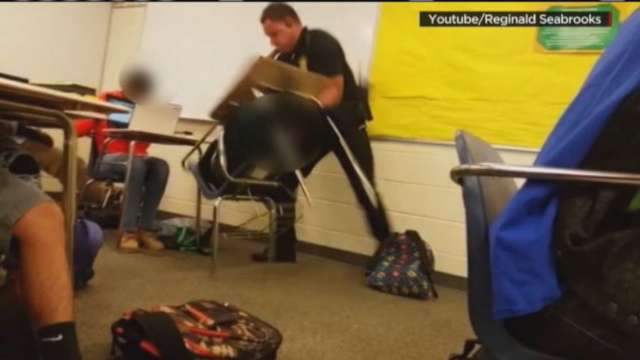
School Resource Officer take down of resistant student from posted You Tube video

Arguably, when the police are called to keep the peace or investigate a violent person call they are required to meet this threat with heightened vigilance for personal and citizen safety.  When a violent person is encountered the use of force continuum comes into play.  In the case of the Columbia, SC high school student who was aggressively choked and slammed to the floor while seated at her desk, the school resource officer was rightfully fired. The student posed no immediate threat such that hands on tactics were required to control a menacing suspect. In this case, the student was angry at being told she needed to put away her cell phone and was defiant to teacher direction. The police were called to the classroom as a show of force when neither the teacher nor the administrator could redirect her behavior.

If the violent person is actively aggressive or menacing with threat of lethal injury to the police or others than there is unlikely going to be any successful de-escalation until the threat of lethal force is eliminated.  If the violent person responds to officer directives to cease and desist all violent action and submit to being taken into protective custody or arrest – only then can mental health assessment be initiated. At the moment of crisis the need for public safety in all violent situations supersedes the individual need for care of a mentally ill person.  In the case of the South Carolina high school student no such threat existed but non-physical tactics were ineffectively deployed. The officer may have been able to diffuse the situation with empathy, understanding, and firm authority. The arrest could not be made without a higher degree of force for an actively resistant student that first punched the police officer.

Sefton, M. (2015) Blog post taken 10-28-2015 https://msefton.wordpress.com/2015/08/23/calling-for-de-escalation-training/

Emotionally distraught – nearly one quarter of all officer-involved shootings go fatal

WESTBOROUGH,MA July 1, 2015 As the analysis of officer involved shootings gradually becomes clear it becomes inevitable that people begin to wonder about the cumulative number of victims of these shootings who may be diagnosed with some form of mental illness.  When it comes right down to it the fact that these persons may or may not of been a victim of unjustified police officer involved shootings will be evaluated on an individual basis based on the use of force continuum to which all police officers adhere. “The underpinnings of violence are often present in some form or another whether or not someone has a mental illness ” according to Michael Sefton, Director of Psychological Services at Whittier Rehabilitation Hospital in Westborough, MA.  Now a groundswell of support has begun for victims of police shootings that may be the result of untreated conditions with psychiatric etiology.  Some are calling for advanced training in crisis management as a way of avoiding officer involved shootings of those who may be emotionally distraught.  I agree to a point that better police-citizen interactions may reduce the incidence of escalating violence.  But this will not work when someone is exhibiting the cognitive confusion and distorted thinking associated with terminal rage.

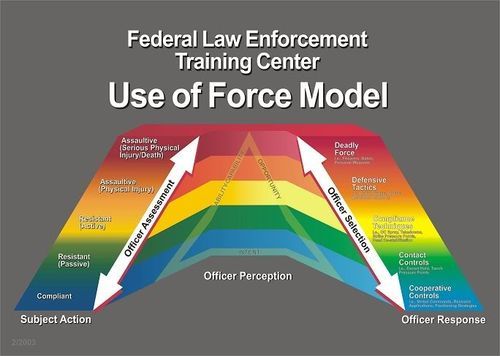
The Use of Force continuum guides officer response to violence and lethal threat

Police officers respond to violent scenes only to face real threats from people who mean to harm them or themselves whether mentally ill or not.  To say that it is because they lack training in techniques of crisis de-escalation that some deaths may have been prevented is unfair and short sighted. Lives may have been saved if those individuals purported to have metal illness had chosen not to pick up a weapon and become menacing.  Lives may have been saved if those same individuals were not intoxicated or high on drugs when they encountered the police and then became menacing. And again, lives may be saved if there were treatment programs available for those same individuals to provide containment of the most violent, unpredictable and paranoid and psychotherapy for those who might profit from the talking cure.  The facts are clear that deadly force was utilized in cases when someone’s life was threatened. Step one of de-escalation training calls for strong voice commands to “put down the weapon”.  In cases where these commands were not heeded the use of lethal force may be a last resort.

Police officers are called upon to use deadly force in the protection of themselves of someone else. Training and experience kick in when violent intentions are directed at police officers who are expected to protect potential victims from violence.  But yelling and pointing guns is “like pouring gasoline on a fire when you do that with the mentally ill,” said Ron Honberg, policy director with the National Alliance on Mental Illness cited in the Washington Post article on July 1. Mr. Honberg fails to realize that if officers are yelling and pointing firearms it is because the force continuum has already exceeded the level of a shoot-don’t shoot lethal force scenario. The degree of response intensity follows an expected path that is based on the actions of the perpetrator not the actions of the police.  The  Post integrated video clips from officer involved shootings and the Longview, TX incident depicts how quickly someone with a knife can cover the distance between two officers.  Read my published blog on the Myth of Mental Illness as it cites the truly low incidence of crime and violence among those diagnosed with mental illness.  (https://msefton.wordpress.com/2015/03/02/the-myth-of-mental-illness-and-school-violence/)

  • kids_imagesThe mere fact that someone has mental illness such as schizophrenia, bipolar depression, or anxiety has less to do with whether or not they are at higher risk for lethal force being used against them. Rather, the behavioral context in which they become involved with police officers, i.e. the “nature of the call” is what guides the and officers tactical use of force along a continuum.  The use of force continuum is drafted by the National Institute of Justice as a template for guiding the response of officers to tactical scenarios of degrees of resistance exhibited by civilians with whom they come into contact. Verbalization of commands tends to be the most commonly used by police in most encounters with resistant persons. For those individuals who exhibit more defiant and aggressive posture officers are permitted the use of elevated degrees of response (increased use of force) including the deployment of pepper spray and perhaps the deployment of a taser or baton for gaining compliance.  A confounding variable in all calls for service – including those where someone wants help for his illness is the co-morbid or co-existing addiction and substance abuse.  Its role on crime and violence elevate the threat exponentially.
  • In a published a blog I have reported that mentally ill persons are no more likely to be violent than individuals without mental illness. However, individuals exhibiting paranoia and those with the acute suicidal ideation are at high risk for acting out violently against police officers and engaging in “suicide by cop” behaviors and place them at greater risk for having lethal force being used against them.  There are no single words that will de-escalate someone who has decided on killing themselves or someone else.  More importantly, the dynamics of the suicide by cop scenario are a lose-lose for everyone involved – except perhaps the suicidal person who gets what he wants.
  • “Nationwide, police have shot and killed 124 people this year who were in the throes of mental or emotional crisis, according to a Washington Post analysis. The dead account for a quarter of the 462 people shot to death by police in the first six months of 2015” (June 30, 2105).  This is but a fraction of the number of persons who experience suicidal ideation on a daily basis who do not act out their behavior in such a destruction manner.  Published accounts have recently blamed the lack of police officer training in managing psychiatric emergencies as a possible underpinning of increased officer involved shootings of persons exhibiting signs of mental illness.  Arguably, as a psychologist who has worked with people in crisis, it is often quite difficult to assess who is most at risk for self-destruction because those who are most dangerous often appear quite sane. 2007 Virginia Tech mass murderer Seung-Hui Cho gave off few clues of his grave intentions before killing 32 innocent students – yet the video taped manifesto left no doubt that he was experiencing significant emotional conflict.  Ultimately, Cho had been hospitalized at least once for depression and paranoia but was free to purchase the firearms he used on April 16, 2007 culminating with his frenetic shooting spree and suicide.
  • In Los Angeles, CA the police have an active mental health response team that assist police officers on scene by “slowing things down” using trained, persuasive negotiation in an effort to defuse high stress incidents and lower the number of lethal encounters.  The program in L.A. seeks greater communication and understanding between the police and members of the mentally ill community, according the the Washington Post.  Mary Jo MacArthur is the assistant chief of the L.A. police training program.  She teaches that those in crisis do not process information like other persons and may experience fear and anger when given verbal commands they do not understand.  The L.A. model provides for professional support from trained psychologists or psychiatrists on scene.  But an officer who encounters an impulsive and violent man menacing with a firearm or knife cannot be expected to de-escalate and “slow down” a volatile situation when the threat of lethal force being used against them or someone else exists in real time.
  • It is inflammatory to say that police did not handle this case or that case appropriately. The use of force continuum is clear that force is met with similar degree of force in order to control and de-escalate. Any other mismatch of force place everyone in grave danger.  Once the lethal threat is neutralized – such as when the mentally ill person drops all weapons and submits to verbal commands to surrender – additional investigation and support may be provided by local mental health teams including hospitalization as needed. Another program exists in Vancouver, B.C. that I will review in my next update.
  • Police officers are regarded as the front line first responders to family conflict and crisis.  The most volatile scenes are those where mental illness coexists with substance abuse like heroin addiction and domestic conflict.  For better or worse, the police have an opportunity to effect change whenever they enter into the domestic foray or crisis involving members of the mentally ill community.  This affords them a window into the chaos and the opportunity to bring calm to crisis. In past blogs I have introduced the notion of aftermath intervention as a means to ending the repetitive nature of those in crisis.  Added training to deconstruct the myths of mental illness after each encounter may be useful but time is seldom provided for such debriefing.  As with many states who review domestic violence homicide – mental health response teams based on the L.A. model and post hoc analysis of red flag indicators of the potential for violence fueled by mental illness i.e. delusions, hallucinations, active PTSD, should be carefully crafted for officer and community safety.
  • “Community policing has long espoused the partnership between police and citizens.  The positive benefits of this create bridges between the two that may benefit officers at times of need – including the de facto extra set of eyes when serious crimes are reported” (Sefton, 2013).  These extra eyes may be called upon to identify red flags as they wave suggesting someone may be headed down the path of destruction.  In the case of some noteworthy domestic violence, post hoc analysis often reveals that people were aware that something was going to happen and not a single person stepped up to strike a warning (Allanach, 2011). Police agencies cannot work in a vacuum and must have the help of citizens if they are to have any impact de-escalating the mentally ill prior to onset of terminal rage.
  • In many cases, the correct response to intimate partner violence should include aftermath intervention when the crisis has settled from the crisis that brought police to this threshold. Techniques for understanding mental illness may facilitate mutual understanding and establish the needed bridge to facilitate treatment. When this is done it establishes a baseline of trust, empathy, and resilience and may lessen the likelihood of the violent menacing that demands force be met with force regardless of the diagnosis.  In the next blog I will identify the role of police officers in pre-incident intervention and identify a chilling case.  By the time a person is in crisis there may be little time to talk “sense” and de-escalate no matter how skilled and well trained the police become.

REFERENCES

  • Ronald Allanach et al., Psychological Autopsy of June 13, 2011, Dexter, Maine Domestic Violence Homicides and Suicide: Final Report 39 (Nov.28,2011), http://pinetreewatchdog.org/files/2011/12/Dexter-DVH-Psychological-Autopsy-Final-Report-112811-111.pdf
  • Lowery, W, Kimberly Kindy, K, Alexander, KDistraught people – deadly results, Taken June 30, 2015 http://www.washingtonpost.com/sf/investigative/2015/06/30/distraught-people-deadly-results/?hpid=z3
  • Sefton, M. (2013) Blog: Aftermath Intervention: Police first to the threshhold. December 8, 2013 Taken June 30, 2015, https://www.msefton.wordpress.com/2013/12/08/aftermath-intervention-police-first-to-the-threshold/