Death by First Responder by Michael Sefton, Ph.D.

“You can’t watch this appalling video posted by brave eyewitnesses on social media without seeing police officers’ callous disregard for a black man’s life,” ACLU of Minnesota Executive Director John Gordon said, calling the death “both needless and preventable.” ACLU of Minnesota Executive Director John Gordon
The death scene in Minneapolis, MN was horrific. I am sickened by the bull shit police work that brings forth justifiably angry people who are themselves suffocating in a society who does not regard them as human. I get that and I share the anger they espouse toward law enforcement. That is not how I was brought up and it was not how I was trained. But not all cops are murderers. First off, there was no need to kill this suspect – George Floyd. No urgent call to control his life and ultimately end it. Mr Floyd had not committed a felony nor was he trying to escape or attack the police. The African American male was suffocated to death by the officer placing his body weight upon the carotid artery of the human being who was in custody. It is well known that once someone is under control and in handcuffs the need for such restraint is reduced appreciably. 
“There will always times when police officers encounter those with mental health needs especially in times of crisis and social disorder. Training and education offer the best hope for safe and efficient handling of cases. A continuum of options for detox, dangerousness assessment and symptom management must be readily available – but here in Massachusetts they are not”  Michael Sefton, 2017
I have had previous posts about the use of force continuum. Officer’s can get off the suspect once control has been established. A law enforcement officer can let up the fight and assuredly, most do so when the fight is over. Whether or not suspect X fought the police after being identified as a suspect in a check forgery scheme or not he did not deserve to die. Even if he were the ringleader in the check forgery scheme and cashed thousands of dollars worth of bad checks, he did not deserve to die. He did not deserve to die. The police will say that the suspect fought until his death – trying to hurt or kill police. Perhaps they will say he was thrashing about and kicking – just off camera. Even if he was the use of deadly force would not be allowed. Bystander video tape will prove or disprove this theory. There is also the body worn camera footage that will surely be published into evidence. From the video released so far, it does not appear that Mr. Floyd was continuing to threaten law enforcement after he was handcuffed. It would appear that the police officer whose full weight rested upon the neck of George Floyd did not reduce his use of force to meet the resistance put forth by Mr. Floyd in kind. That is a serious abuse of power and the officer is now being held on the charge of murder in the second degree. 
“It emphasizes accountability, making amends, and — if they are interested — facilitated meetings between victims, offenders, and other persons like the police.” Center for Justice and Reconciliation
Community policing requires not only programs bringing community members together with police officers in various ways including block meetings, police athletics leagues, and “coffee with a cop” but also developing a mutual trust between law enforcement and the people they are sworn to protect. How does this happen? Police chiefs, deputy chiefs, superintendents, command staff, and patrol officers need to press some flesh out in the neighborhoods. Trust and visibility brings forth accountable and transparent policing. By doing so it opens the doors to community membership by inviting input and honest dialogue.  Restorative justice is a process that slowly repairs the harm caused by crime and malfeasance through ongoing dialogue, respect, and genuine contrition even as it pertains to police abuse of power. Community members, including police officers, and victims of abuse meet for talks aimed at transforming mistrust and anger.  Policing reforms are being introduced from coast to coast Most cities have (again) banned the choke hold that was taught but not permitted in 1982 when I first went through police training. On June 22, 2020, a NYPD officer was put on unpaid suspension for again choking out a suspect who was black. The suspect survived the arrest and was checked out at a local hospital. Meanwhile, the work of the police must continue especially now as Americans learn what to expect from the new normal and beyond. Call 911 if you have an emergency and need the police. 

Harlem domestic violence homicide calls for transparent psychological autopsy

The psychological autopsy is an individually designed case study that elicits a broad range of factual data regarding the behaviors of a decedent in the immediate day or days leading up to domestic violence homicide. The study is especially important when first responders and essential workers are involved all the while a pandemic ravages the city in which they live. Michael Sefton, Ph.D. Direct Decision Institute, Inc.

The recent domestic violence homicide in Harlem raises the specter of an essential city worker who killed his sister-in-law while his wife called for help. The police stopped the attack resulting in the death of Ubaldo Gomez but not before he shot and stabbed a women in the head with a kitchen knife. The fact is that domestic violence has increased during the pandemic as it does at other of life’s stress points. Did the fact that the alleged murderer was an MTA employee considered to be “essential personnel” have an impact on his mental health that may have been foreseen? What role, if any, did his role as an auxiliary police officer for the NYPD have in the terminal event? A psychological autopsy would answers these questions and establish a worst case scenario of frontline exposure to trauma and possibly offer insight into underlying history that may have been anticipated and stopped. Certainly the hierarchy at 1 Police Plaza will have an interest in this case. The Corona virus has added to risk of DV and DHV.

For too many women who are abused repeatedly during times of crisis there is no place to run and no one to keep them safe. Orders of protection are ineffective and without GPS monitoring and they are nearly impossible to enforce. In a 2011 domestic violence homicide in Maine, the protective order was violated 4 times by Steven Lake who killed his wife and children in Dexter before killing himself in June 2011. That alone was grounds to hold Lake without bail. No police agency removed access to his collection of over twenty firearms. The scene diagrams illustrate how Lake was armed with two firearms and a hunting knife. He murdered his children while forcing his estranged intimate partner to watch. It was thought that he planned a murder spree and he left 9 suicide notes. The final despicable act, as police arrived, was to attempt to light the bodies on fire.

In general, there is little interest in such a comprehensive post hoc psychological examination because there is no pending prosecution. Nevertheless, a psychological autopsy conducted on Lake in the Fall of 2011 revealed a clear timeline littered with red flag warnings that were missed or ignored. The research conducted in 2011 was done pro bono. It undertook over 200 hours of interviews and presented the Domestic Violence Review Board with over 50 recommendations for reducing high rates of domestic violence homicide in Maine (Allanach et al. 2011). The medical autopsy editorialized the case in its final report:

“Despite receiving some mental health counseling it is apparent, in retrospect that the degree of violence and anger possessed by the abuser was not realized.”                                                            Chief, Maine State Medical Examiner

This latest case in point involved an estranged wife, her sister, and the building manager in Harlem. The three were having dinner when someone armed with a firearm broke into the apartment. It was the estranged husband of one of the women. He was wearing his Metropolitan Transportation Authority uniform, and he had a gun according to the NY Post reports. In the meantime we have been told that the perpetrator was an auxiliary police officer and was licensed to carry a firearm. What triggered this paroxysmal violence? If it was foreseeable, then Mr Gomez should not have had access to his firearm.The psychological autopsy will address prior history of intimate partner violence, protection orders in place, work-related stress, recent health concerns related to the corona virus and Mr Gomez trauma exposure history, and his mental health in the days before the murder. 

Police officials said the transit worker, Ubaldo Gomez, shot his sister-in-law and stabbed her in the head with a knife, while his wife reached out for help. When Gomez refused to drop a 12-inch kitchen knife and tried again to stab the man, a police sergeant opened fire, killing him. In the end, there is always at least a single person who knows what is about to happen and often does nothing to stop it. A family member of Gomez suggested “he had some mental issue, something happened. He was always working day and night. He barely slept. He worked.” as quoted in the NY Post. Whether this duplicity and denial stems from cultural beliefs about the supposed “privacy” of DV, society must change the way in which law enforcement manages these cases. The buy-in from police, legislators, judges, probation, and the public-at large needs to be fully endorsed for real change to happen and for safety plans to work. Many states across America are planning to enact “red flag” rules that will remove weapons from individuals with a known history of domestic violence e.g. choking spouse during fight (Sefton, 2019).

Family members who may be in the crosshairs of these insidious events often see but lack the knowledge to stop the emotional and behavioral kinetics once they start. The fear of being murdered by an intimate partner creates emotional paralysis. In a large percentage of DV occurrences, financial and self-image influences as well as outright fear of the abuser by the victim limit moves toward safety. Therefore, a continuum of interagency cooperation is needed to effectively measure risk and understand the pre-incident red flags that are common manifestations of abuse and often forecast terminal violence, all of which occurred in this case. As the totality of these red flags comes into focus it becomes incumbent upon each of us to take action to prevent domestic violence threats from becoming reality (Allanach, et al. 2011).

It would seem to be vitally important that a transparent psychological autopsy be initiated to gain an understanding of the factual behavior that was observable and measurable in the days leading up to the murder especially given the likely unintended victim. Preliminary reports described Gomez as having a pattern of pathological jealousy and victim stalking. For her part, Gomez’ wife Glorys Dominguez called for help in the weeks prior to the terminal event seeking help.

active shooter addiction Bail conditions in domestic violence CIT Community Policing crisis intervention Dexter domestic violence domestic violence homicide DV DVH DV Homicide extended family fitness health psychology intimate partner violence jail diversion Law Enforcement Leo Polizoti Maine Mass shooting mental health mental illness Michael Sefton parenting Personality Police police behavior police mental health liaison police officer police suicide pre-incident red flags psychological autopsy PTSD red flags Resilience Ron Allanach Sefton Sefton Blog Social skills Suicide terminal rage toxic relationships violence workplace violence

Allanach, RA, Gagan, BF, Loughlin, J, Sefton, MS, (2011). The Psychological Autopsy of the Dexter, Maine Domestic Violence Homicide and Suicide. Presented to the Domestic Violence Review Board, November 11, 2011

Sefton, M (2019) Violence prediction: Keeping the radar sites on those who would do us harm. Blog post https://wordpress.com/block-editor/post/msefton.wordpress.com/5012 taken May 23, 2020.

Sheehan, K, Moore, T. Woods, A. NY Post May 21, 2020 https://nypost.com/2020/05/21/man-killed-in-nyc-police-involved-shooting-was-auxiliary-cop/?

Benchmark behaviors for healthy police service

Law Enforcement flag

What are the bench-mark behaviors that are reflective of healthy police officer career development? How does a young man or woman go from a squared away academy graduate to an over burdened, irascible and embittered mid-career cop? There is a growing literature that suggests officer behavior and law enforcement culture become instilled in the field training process that takes place immediately following successful formal classroom training. The answer to the question about officer embitterment is a mystery but after spending time with members of law enforcement in Chicago in late March 2019 it begins to become apparent that police officers grow and remain productive in an environment of support: both within the organization and within the community in which they serve.

There are factors intrinsic to law enforcement that detract from career satisfaction like the risk of personal harm or death, career ending injury, time away from family, shift work, and forced overtime. This is a well known set of stressors that officers learn shortly after signing on. But things that may be unexpected include the quasi-military chain of command that often stifles education and innovative thinking, professional jealousy, arbitrary executive orders, the lack of opportunity to participate in policy making, nepotism among non-civil service personnel, and the lack of support for the sacrifice made by the field qualified troops for physical and behavioral health injuries. The period of field training differs from job to job. Field training picks up where the academy classroom education leaves off. Newly minted LEO’s all must undergo field training and are assigned to a single field training officer (FTO) who provides on-the-job training about the realities of frontline police work and closely monitors officer behavior and responses in the field.

Field training usually lasts between 12-18 weeks and was first initiated in San Jose, CA in 1972 according to research published in 1987 by McCampbell of the National Institute of Justice at DOJ (1987). “The primary objective of the Field Training and Evaluation Program (FTEP) is to ensure that all probationary police officers receive optimal field training, predicated upon staffing the Field Training Officer position with qualified officers, and to ensure through proper training and evaluation that only competent, motivated, and ethical individuals become Chicago police officers” as published in the Chicago PD Field Training Program and Evaluation Standards (2018). Field training officers have specific training in mentoring with an understanding of the demands of “street work” and the transition from classroom recruit to patrol officer. The FOR training process lasts several weeks as seasoned veterans learn how to be mentors and evaluation the training needs of individual probationary officers. 

The selection of FTO’s differs from department to department and has implication on long-term officer success. Attrition rates exceed 25 % under the FTO’s leadership and tutelage in many agencies. FTO’s can be expected to experience training fatigue and should be permitted time between assignments. “Dworak cautioned about agencies falling into situations in which they over-work their FTOs, resulting in diminished quality of work, and subsequently, decreased value delivered to the recruit being instructed” Wyllie, 2017

“The FTO is a powerful figure in the learning process of behavior among newly minted police officers and it is likely that this process has consequences not only for the trainee but for future generations of police officers that follow.” Getty et al. (2014) There is little standardization of training protocols aside from FTO catechizing war stories day after day with tales from the street followed by endless inquiry over possible decisions based on department protocol as the sometimes defiant FTO sees fit.

“New officers can be taught when to legally arrest and use force, but the academy cannot instill in each trainee the breadth of intangible, community, value-based decision-making skills that are necessary to manage unpredictable incidents in varying situations.” Getty et al. (2014)

FTO’s are closely monitored by the department training hierarchy and are required to provide daily observation report as to the demonstrated progress of probationary police officers toward developing competence in over 10 areas of police-related duties including decision making, judgment, court testimony, use of force, etc. At the end of each 28-day cycle FTO’s submit a detailed review of progress and potential deficiencies that arise. In Chicago, IL a probationary police officer (PPO) must complete a minimum of 3 28-day cycles with an FTO. It is known that FTO’s help to instill the police culture in PPO’s including policing by the book and prevailing beliefs and attitudes as they exist within individual agencies. I strongly believe that FTOs play a role in reinventing the police service and lowering the stigma associated with behavioral health and response to exposure to trauma.

Job satisfaction is greatest soon after the law enforcement officer is taken off field training and designated “field qualified”. Following the 12-18 week field training officers remain on probationary status for up to 2 years from date of hire. There is some thinking that FTO behavior rubs off on PPO’s and can impact career identity including misconduct later on long after field training has ended. Officer resilience depends upon solid field training with adequate preparation for tactical encounters, legal and moral dilemmas, and mentoring for career development, job satisfaction, and long-term physical and mental health.

Chicago Police Department (2018) FIELD TRAINING AND EVALUATION PROGRAM http://directives.chicagopolice.org/directives/data/a7a57be2-1294231a-bf312-942c-e1f46fde5fd8c4e8.html taken March 29, 2019.

Wyllie, D. (2017) Why the FTO is one of the most important police employees. Police One https://www.policeone.com/police-products/continuing-education/articles/338249006-Why-the-FTO-is-one-of-the-most-important-police-employees/ Taken March 30, 2019 Sun, I. Y. (2003a). A comparison of police field training officers’ and nontraining officers’ conflict resolution styles: Controlling versus supportive strategies. Police Quarterly, 6, 22-50. Getty, R, Worrall, J, Morris, R (2014) How Far From the Tree Does the Apple Fall? Field Training Officers, Their Trainees, and Allegations of Misconduct Crime and Delinquency, 1-19. McCampbell, M. S. (1987). Field training for police officers: The state of the art. Washington, DC: National Institute of Justice.

Positive Policing and Purpose in Life

Purpose in life has been introduced as benefiting people, including law enforcement officers, to find a positive sense of purpose and personal satisfaction in their work product and in their lives. It was originally espoused by Viktor Frankl in 1946. Frankl, a physician, survived the German concentration camps and the deliberate extermination of 6 million Jews during WW-II. His wife and entire family were killed at Auschwitz and Dachau. How could he possible find purpose and meaning in life after this horrific experience. In the book Man’s Search for Meaning, first published in 1946, Victor Frankl shares the experience of seeing hundreds of people herded off to their extermination. People and members of his immediate family were horrifically gassed and sent to mass graves. Frankl’s theory holds that “there are three primary human capabilities, or, in his words, noological possibilities: self-detachment, self-transcendence, and the ability to “spiritually be in touch” with something or someone independent of spatio-temporal dimensions” according to McGann (2016) who reviewed Frankl’s book Man’s Search for Meaning.
Officer well-being is essential for career longevity. It becomes apparent that police officers grow and remain productive in an environment of support: both within the organization and within the community in which they serve. These attributes build a sense of personal meaning and career purpose. Leo Polizoti, Ph.D.
In Man’s Search for Meaning, Frankl described the daily demoralizing prisoners underwent both physically and psychologically. Survivors of the horrific images at concentration camp Auschwitz began to find meaning in their forced labor – even humor along with camaraderie. Many of us glean a significant sense of well-being from what we do personally and professionally. Most cops derive great personal meaning and purpose from the job of police officer at least for the first 3-5 years. Law enforcement officers’ derive much of their identity from the work they do on a daily basis and can experience wide ranging stress from call to call. As such, it has become well-known that police work requires special understanding of one’s community and a positive sense of personal responsibility, well-being and resilience for career success and hardiness (Polizoti, 2018).
Our tour guide at the West Bank in Israel in 2019 – Rami Nazzali found great purpose in teaching visitors about the plight of Palestinians on the West Bank and Gaza Strip – He strongly believes the plight of Palestinians in the Gaza Strip and West Bank are fighting for purpose and meaning in their lives. Rami Nazzali writes for The NY Times.
Purpose in life refers to an underlying belief that what you do for work has importance and purpose on a larger scale. Moreover, to diminish oneself as a result of career embitterment runs a risk of the erosion of purpose and loss of group membership. That is when one becomes marginalized and loses his purpose and the “why” for living. Viktor Frankl believed that once gone the purpose of life and the will to live cannot be restored. Mark Dibona previously was a patrol sergeant for the Seminole County Sheriff’s office in Florida, where he supervised nine officers, but the memory of the June morning where he was called upon to resuscitate and dying infant still haunts him. “Other stressful situations include, but are not limited to: long hours; handling people’s attitudes; waiting for the next call and not knowing what the situation will be; and even politics within the department. Then, on top of it all, officers are frequently criticized, scrutinized, and investigated for decisions they make” said Michelle Beshears on the faculty at American Military University. Among police officers between seven percent and 19 percent of police officers experience symptoms of Post-Traumatic Stress Disorder, compared to 3.5 percent of the general population. A colleague and friend, Sergeant Mark DiBona retired from law enforcement in 2019 has had some difficult times on the job in Florida that effect him in a profound way. He is an strong advocate for law enforcement mental health and suicide prevention. “Until this day,” said Dibona, who admits to having contemplated suicide several times before he began counseling, “I can feel the warmth of that baby on my arm.” A child Mark believed he could save.

Thailand: Royal Thai police face daunting job to reform national agency

“Police suicides and police apathy are two of many issues highlighting a dire need for constructive police reforms within the Royal Thai Police for some time.” Bangkok Post October 14, 2019 The Thai National Police (TNP) are mired in politics and age-old tradition which has contributed to significant tension within the TNP ranks.

As recently as early February, 2020, an embittered Thai police officer went on a rampage in the northern province in Thailand. Over 20 persons were killed in an extremely rare display of public rage and terminal violence. The perpetrator ultimately took his own like as members of the Thai Special Forces moved in.

Dr Ronald Allanach and Dr Michael Sefton are pictured with the Northern Police District Administrator during a meeting 2 weeks before the rampage. There was no sense among the officers we met that tension and despair underlie this outwardly professional police agency. The officers we interviewed were all happy and content with their assignments. There was no sign of the frustration and vulnerability identified in the Bangkok Post report.

Dr. Ronald Allanach (left) pictured with Northern Sector Thai National police administrator and Dr. Michael Sefton in January 2020

Police reform is a problem across America and the world. In Thailand, a centralized police force is overseen by the country’s prime minister who is responsible for naming the chief general who leads the Thai National Police. This is no easy task. Some believe there are complex issues that contribute to the distress felt by police across Thailand. The investigation into the February 2020 rampage is in its early stages but links to conflict between the officer and a higher ranking administrator are being floated. A psychological autopsy would provide added facts to the “red flags” that may have lead up to the terminal event and offer substantive interventions that can reduce the growing problem in The TNP.

These include officers who are sent to distant police assignments leaving them without the normal emotional and agency supports they need. The pay is low and the trust felt by the TNP from its citizenry is inauspicious at best.

In a 2018 published paper in the Journal of Humanities and Social Sciences by Police Major Thitiwat Yachaima, similar factors affect the levels of stress in Thai police officers as that impacting cops in the United States. This includes work environment, relationship to superior officers and peers, specific work and hours of weekly service, support from family

“Today police morale and emotional health have hit rock bottom, he said, because of a number of factors, including botched policy-making when it comes to their career path that doesn’t take into consideration the officer’s needs and desires.”

Bangkok Post December, 2019

The Bangkok Post published an article about police suicide in Thailand. According to the Bangkok Post, “four police officers – based in Chumphon, Chiang Mai, Sing Buri and Kamphaeng Phet – were overwhelmed by stress and took their own lives after being transferred from their home provinces to investigation units in the other provinces.” 

More recently, police officers in Thailand have been able to request transfer to their home provinces in an effort to reduce the stress experienced by newly deployed officers and other specialists. There are over five thousand unfilled positions in the investigation units for the Thai National Police. As a result of this shortage, it requires that officers be shared among divisions across the country adding to the stress officers’ experience.

Overall, Thai police are defensive about the underpinnings of officer suicide citing “physical health and personal problems” as a primary source of the problem – not simply job assignment. National police chief Pol Gen Chakthip Chaijinda has recently come under attack from subordinates for making what appeared to be abrupt, politically motivated transfers for those who challenged his authority as he nears retirement age.

What factors need to be examined when looking to reduce police stress in general and to understand factors that are shared among law enforcement officers across societies? A study conducted in 2011 in the Journal of Nursing Science suggested that officers who have self-efficacy and respect from the communities they serve as among the factors that yield the greatest health-related behaviors and personal hardiness.

A Behavioral Health Bill

In the 1970’s there was a bill that allowed police officers who earned their college degree to be paid extra money called the Quinn Bill. The Police Career Incentive Pay Program was enacted by the Massachusetts Legislature to encourage police officers to earn degrees in law enforcement and criminal justice according to the Massachusetts Department of Higher Education website. The funding for this ended in 2012 when the Commonwealth of Massachusetts stopped paying its share to cities and towns across the state. Officers hired after 2009 were not eligible for this program. In many cases, officers earned thousands of dollars on top of their base salary to continue their education. Many officers went on to earn advanced degrees and came to depend on this funding.

“Public safety is a priority, and it is essential that we have a highly trained and educated police force to keep our community safe.’’

Hon. Setti Warren, Mayor of Newton, MA

In Newton alone, the money to pay its police officers with earned an earned college degree amounts to an annual budget amount of 1.3 million dollars according to Mayor Setti Warren who believes it is worth it. Newton and many other communities in Massachusetts have continued payments to officers even after the state subsidies were no longer available. It is the right thing to do. In a similar way, reimbursing cops for “wellness training” should include subsidies for mindfulness and voluntary critical incident defusing sessions with peers following high lethality-high acuity events such as an active shooter incident.

Officer wellness is a vital component to resilient community policing. Officers who are resilient and mentally healthy provide better response to citizens in crisis. Just as it is important for law enforcement officers to be rewarded for continuing their education legislation may be enacted that provides funding for officers who undergo behavioral health and fitness training when it is associated with job-related trauma and mental illness. Peer support and crisis intervention training (CIT) teach LEO’s the skills needed to support fellow officers in need and deescalate people in the field who are in mental health crisis. By doing so, they avoid use of force and potential civil action against the police from use of physical force or incidents of officer involved shooting (OIS).

Officers are urged to sign up once they are released from formal field training and agree to be open to behavioral health follow-up moving forward. They do so after seeing the department psychologist to review incidents they have experienced in their early careers. Once cleared they agree to participate in regular defusing sessions in the aftermath of high profile incidents. At the same time, they may keep an electronic behavioral health profile with dates of traumatic cases and their role and response to each. If the LEO wishes to share these self-reports the department psychologist may have access to the case files and individual behavioral health responses. Family members would have access to the department psychologist if deemed necessary. There would be mandatory meetings with the department psychologist following OIS incidents and at other times depending upon department regulations and protocols.

Once a police officer opts to join the Career Behavioral Health Resiliency program he or she would receive a stipend that would be commensurate with the total time allotted to their participation wellness and resiliency programming. They can go all in and receive an annual incentive for both the resilience they achieve and for being part of the peer support network that might include mentoring another officer who is struggling with career embitterment or from the effects of repeated trauma. In some cases, an officer may choose not to mentor a fellow officer but agree to personal growth and mindfulness activities along with participation in educational offerings. The program would be a win-win all around by raising the behavioral health and emotional stamina of the troops in the field and the chain of command.

I suggest proposing a law enforcement version of “no man left behind” ethos espoused in the U.S. Military. There should be a path to recovery for most police officers who are willing to receive this current “best practice” standard of care leaving no man or woman behind. Dr. John Violante, a University of Buffalo research scientist and former N.Y. State Trooper believes “police officers have a moral duty to care for members of law enforcement who are in crisis”. This will put an annulment on the stigma associated with the human response to trauma that often leaves officers feeling alone and ostracized by the men and women with whom they serve. By using a robust peer support network and collateral police psychology model officers may develop a sense of normalcy for intervention following high acuity calls.

The International Association of Chief’s of Police (IACP) has a broad-based Mental Wellness program it is reporting on its website that highlights the importance of this kind of support. “The IACP, in partnership with the University of Pennsylvania (Penn) and the Bureau of Justice Assistance (BJA)’s VALOR Initiative, is customizing a program specifically designed to help officers and agencies by enhancing resilience skills. The cost of such a program will reap rewards in the form of career longevity, officer well-being, officer morale, quality of community policing, and greater faith and trust in law enforcement in general.

copyright 2019 Direct Decision Institute

Domestic Violence Awareness October 2019

Today, as we read about another family destroyed in domestic conflict here in the Boston area, I can imagine the images seared into the eyes of those who responded to the call finding 3 children dead along with their parents.  The Abington, MA police chief described the death scene in the Boston Globe as “something unimaginable”.  Some people are better equipped to handle horrific cases where death is on public display – perhaps even today’s horrific domestic terror attack here in Massachusetts. Others become impacted by the recurring images and how they are all the same after a while. Too many calls resonate with the officer’s personal well-being and safety leaving him or her constantly on guard. But over time – even the neurosurgeon – will become harmed by embitterment when his learned craft can do nothing to fix a leaking brain and his patient dies. Perhaps he feels that with updated equipment and training he may have been able to save the life?

This is what LEO’s face.  A loss of purpose in life and the unmitigated stench of a decomposing society over which they have no control and, too often, a internal command structure who does not know what it is like to be in a lonely barn at 2 AM and see the hanged remains of someone who, after 5 hours, would leave even the most hardened of us on our knees and wanting out.

October is Domestic Violence Awareness month. Cases such as today’s Abington murders often leave emotional tracers that can grow a database which LEO’s can utilize when investigating calls for service. Lives will be saved when society takes a closer look at red flag violence – these are the pre-incident indicators that violence and domestic violence homicide are at highest risk (Sefton 2018). Some behaviors are secretly guarded among intimate partners – as “nobody’s business”. Police officers must inquire and listen carefully to the victim who firmly believes her spouse intends to kill her. The underpinnings of her fear are generally spot on as in the case I that investigated in Maine using the psychological autopsy in 2012. For the cases with high likelihood of domestic violence homicide, greater care for victims must be initiated from the beginning before it is too late. It can be a hard sell, I know, but the reports we write must also be “spot on” when it comes to dangerousness, risk, and containment.

Sefton, M (2018) Violence prediction: Keeping the radar sites on those who would do us harm. Blog post: https://msefton.wordpress.com/2018/05/20/violence-prediction-keeping-the-radar-sites-on-those-who-would-do-us-harm/ Taken October 8, 2019

Another look at self-destruction in law enforcement and its septic underpinning

This is a photograph produced by Dave Betz who lost his son (pictured) in 2019 to suicide.

Officer Dave Betz lost his son David to suicide in 2019

The code of silence.  It surrounds the culture of police work and always has.  I was once told there are two kinds of people: police officers and ass holes.  If you were not a police officer then you were an asshole.  It was a brotherhood with a formidable blue line that defined the police service as a singular force against all that is bad.  Some have said that law enforcement offers a front seat to the greatest show on earth.  Until what is viewed in the front row cannot be unseen and slowly chips away the veneer of solidarity by threatening the existing culture.  For police officers to have long term career success the organization must come to grips with its membership and relieve them of the stigma they feel that prevents them from coming forward. Who would go for that?

If the organization devalues its rank and file for experiencing the natural, neurobiological reaction to repeated, high lethality exposure to violence and death, then who would join such an organization?  Fewer and fewer applicants are signing on in 2019. If a police officer is emotionally denuded by the job why would he or she step up and break the code of silence and be labeled a “nut case” only to lose his badge, firearm, and police authority?  No one will sign on for that kind of treatment.

Each time a member of the law enforcement community takes his or her own life the unspoken silence becomes a lancing wound to the festering emotional infection that is from repeated exposure to traumatic events. The reappearing wolf in sheep’s clothing cuts his teeth on the souls of unwavering academy graduates now paired with senior field trainers who promise to teach the tricks of the trade. Academy graduates come forth like professional athletes with all the confidence and enthusiasm of an elite athlete.  They need experience and mentoring so they know what they are up against.  I was asked to speak at the annual Society of Police and Criminal Psychology meeting in Scottsdale, AZ in late September, 2019 on the importance of the field training program on long-term officer wellness and career satisfaction.

Country music blared from the car radio as Dave, dressed in pajama pants and a t-shirt, stood over his son and realized he was dead.

Father of 24-year old police officer David Betz, 2019

The psychological autopsy may provide insight into the manner of death and must include prior exposure to trauma.  How many first-in homicide calls had the decedent handled? How many unattended SIDS deaths?  How many death notifications? How many cases of domestic violence where the victim was too frightened to speak about the nightly horrors in the marital home? How many times did he witness the remnants of a violent motor vehicle crash with ejection?  Each time he bears witness to this inhumanity he risks never coming back. Some spouses will say they remember when they lost a husband or wife. “It was after the 4-alarm fire – sifting through the rooms for possible causes and finding the old woman who rented the place in an upstairs bathtub” or “the time the addict threw his newborn son off the 14th floor balcony because his baby mama did not return from work when she was expected.” Many espouse the use of the psychological autopsy as a way of honoring an officer who died by suicide as a means of linking the suicide to their tour of duty. 

High lethality calls must be tracked allowing for paid psychological defusing time in the aftermath of these calls.  Defusing and psycho- education can be provided for the entire group who handled the high lethality call rather than identify a single officer.  Aftermath check-ins and peer support should follow. An officer who begins to exhibit changes in his normal work routine, e.g. increased tardiness, citizen complaints, or substance abuse should be referred for psychological follow-up that is linked to annual performance reviews and recommendations for corrective action.

In truth, the reader may wish to put himself into the position of the first arriving police officers at Sandy Hook Elementary School in a place called Newtown.  In December, 2012, twenty seven people were violently murdered – most were first grade students. I have read the Connecticut State Police report of the Sandy Hook shooting and was left feeling numb and physically sickened. It is over 1000 pages of grueling detail.  Now, when I see TV images of LEO’s running on campus toward the sound of gunshots, I know they must step over the desperate victims, some of whom take their last breath reaching for a pant leg or a blue stripe or a black boot covered in blood all the while begging to live.

Recruits enter the police service with high hopes of making a difference but quickly learn that their purpose in life is being sucked out of them like embalming fluid moving though the lifeless remains of a brother or sister officer who could endure no more. Coming forth and asking for help is not a sign of weakness but a sign of strength, resilience, and heroism. There should be no penalty or secondary administrative sanction when an officer comes forth.  They must be provided behavioral health treatment and a pathway to return to the job.  

Police officer suicide impacts police agencies everywhere in America and across the globe. Many officers feel abandoned by their agencies and become marginalized because they struggle with depression, substance abuse, and PTSD after years of seeing the worst life has to offer. It is time to lessen the expectation of shame among the troops who serve communities large and small. No father should be first in at the suicide death of his own son and be expected to stand with a photo and share his story at the same time he remains stoic and brave.

Job satisfaction: Attrition and “exodus” in Seattle

I just finished a grant proposal looking at the effects of biofeedback on depression and embittered in early and mid-career law enforcement officers. A common complaint with retiring officers and many who leave is not being supported by the agency leadership. Embitterment and attrition go hand in hand but a “mass exodus” bespeaks trouble in paradise. I would like to study the effects of physiological biofeedback on LEO depression and emotional embitterment with a goal of reducing suicide with the goal of enhanced officer well-being. This study will not do much to explain the increase of resignations in Seattle but the data speaks for itself. The Emerald City has lost some luster and the trust of its troops.

Police chiefs frequently ask what can we do about officers who are trained and then leave the department after 1-3 years of service? This is a large problem in small and medium-sized departments. A study was published looking at the exit interview data from departing officers in the Seattle PD and what factors contributed to their decision to leave. According to Jason Randz who has a radio show at KTTH in Seattle, the mass exodus is linked to disgust at the city leadership including aggressive city council over site.

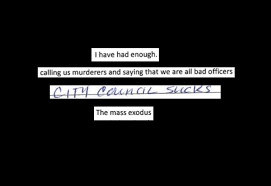
Copy of scathing response to exit inquiry

“There are lots of people walking out the door,” an officer explained. “This is a mass exodus. We’re losing people left and right. Why stick around when the City Council doesn’t appreciate you? [These officers are] fleeing the ‘Seattle mentality.’”

It is unlikely that a true mass exodus is taking place as some believe in the great Northwest. All large departments have officer turnover that can cause difficulty for recruiting efforts. In 2019, it has become more difficult to recruit men and women for the police service across the country. The Seattle story cites over three dozen officers who have left or are planning to leave the SPD because of feelings of unhappiness with the city. A true copy of one exit interview is shown above “New strategies will be essential to fill not only the recruitment gaps, but also the tremendous loss of organizational knowledge that will accompany the impending mass retirements. Few would argue that a department full of rookies at every level is what the profession needs, especially if those rookies are from a generation that craves immediate approval and recognition” as described in a paper published in Police Chief Magazine entitled A Crisis Facing Law Enforcement: Recruiting in the 21st Century.

According to Chief Sid Smith, “with the growing public concern over police use of deadly force, this mental health issue presents another challenge for the recruiters and places an added burden upon the mental health professionals retained to more carefully screen all applicants, including military veterans”. In a prior post the topic of protective factors for success in law enforcement are listed but a substantial factor impacting job satisfaction and career hardiness is perceived support from management and city government including members of city council and in some cases strong mayors. In 2014, the Seattle Police Department appointed Kathleen O’Toole, a former Boston Police Commissioner, to lead the agency which was under federal consent decree for cases of alleged excessive force. She resigned in 2017 for personal reasons.

The Field Training Officer: Important things they may not know

Most departments has active field training protocols that recruits must pass after leaving the academy.  This means they ride along with the FTO until they are ready to function independently as LEO’s.  The specific time line for this depends on FTO daily observation reports during the phases of field training.  These begin with close supervision where the trainee does little of the daily work. In the latter phase of training the FTO may pull back and provide intervention only if needed by allowing the trainee to be the lead on all calls.

Officer resilience depends upon solid field training with adequate preparation for tactical encounters, legal and moral dilemmas, and mentoring for long-term physical and mental health.  Michael Sefton, Ph.D. 2018

Law enforcement officers begin their careers with all the piss and vinegar of a first round draft pick.  This needs to be shaped by supervised field training and inevitably will be effected by the calls for service each officer takes during his nightly tour of duty. Much like competitive athletes, law enforcement officers at all levels exhibit “raw” talents, including leadership abilities and the cognitive skills to go along with them.  Moreover, like competitive athletes, these raw abilities have to be honed, refined and advanced through a combination of modeling, coaching and experience in order for the officer to develop the skills needed to improve performance, as well as prepare them for career advancement according to Mike Walker.  This important task falls upon the field training officer (FTO) and is a critical phase in probationary police officer’s development.  “The FTO is a powerful figure in the learning process of behavior among newly minted police officers and it is likely that this process has consequences not only for the trainee but for future generations of police officers” according to Caldero and Crank (2011).  In 1931 the Wickersham Commission found over 80 percent of law enforcement agencies had no formal field training protocols for new officers entering the field of police work described by McCampbell (1987). In 1972, formalized field training protocols were introduced by the San Jose, CA police department that became a national model for post academy probationary field training.

Just before I was promoted to sergeant while working for a law enforcement agency, USCG Vice Admiral John Currier, a friend of mine said to me: “Michael, move up or move out”.  I wasn’t sure what he meant by that but given my 9 years as a patrolman, I started to lobby for a promotion to sergeant.  The agency at which I worked had little turnover in the middle ranks so I was never sure I would get a chance for promotion.

All law enforcement officers should have a career path when they graduate the academy that lays out a career path based on officer interest, career improvement goals, on-going training interests, and agency needs.  Training opportunities offer new officers the chance to gain experience in anything from specialized investigations i.e. sexual assault and child abuse, firearms instructor, domestic violence risk assessment to bike patrol and search and rescue.  Our chief believed strongly in incident command, active shooter response, and emergency medical technician training.  I went on to take the paramedic technician course at a local college in 2011-2012. In many ways my former agency was well ahead of the curve in training opportunities and tactics including use of body worn video cameras, taser training, stop sticks, and individually deployed patrol rifles.  I was encouraged by my chief to participate in a research opportunity I was offered in domestic violence homicide from a case in northern Maine, a community much like the one I served. From this research we introduced a risk assessment instrument developed by  Jacquelyn Campbell.

The chrysalis for me came in August, 2012 when I was appointed by the Select Board to sergeant at the recommendation of my chief.  Before this could occur, I had put in a significant amount of time developing a field training program, domestic violence awareness and lethality assessment protocols, and police-mental health encounter training. I learned the hard way that most police officers do not like working with citizens with mental illness and hate attending training classes on mental health awareness and crisis intervention training. I realized that I needed to become a leader and in order to do so I needed to become better in communicating with the troops and with those up the chain of command. In order to develop leadership I was sent to sergeants school but what I learned was the importance of being a role model for those in training and to teach by doing, teach by example. I also learned that field training is demanding, exhausting work if done with the precision needed to fully socialize the trainee and provide needed modeling while gradually offering greater independence for the trainee.

cropped-images.jpgField training involves months of practicing ‘what if‘ scenarios, learning the ropes of the police service, use of force, and writing reports. Early in the phase of training the tough discretionary decisions faced by a probationary officer are made by the senior training officer based on prior judgement, experience and what is most prudent for the specific incident and conditions on the ground.  “Agencies should thus maintain a greater degree of FTO supervision, not just trainee supervision. Such an effort would go a long way toward improving FTO programming and better informing the needed research base” Getty et al. (2014, pg. 16). Field training is often time limited with special consideration for officers who need additional training in specific skills or personal areas of concern. Some officers are put on career improvement plans and extended field training, when needed, and some probationers are discharged from the agency because of skills or behavior that are not compatible with police work. Law enforcement agencies want active police officers who represent the core beliefs of the agency and individual community needs.

Field training has perhaps the most potential to influence officer behavior because of its proximity to the “real” job according to Getty, Worrall, and Morris (2014).

Probationary officers can be taught the how and when of effecting an arrest but the intangible discretionary education comes from FTO guidance and socialization that takes place during the FTO training period.  Research has revealed that officers’ occupational outlooks and working styles are affected more by their FTOs than formal “book” training, Fielding, 1988.  The selection of who becomes an FTO is not well defined.  In a study at Dallas PD probationary trainees were exposed to multiple FTOs over 4 phases (Getty et al. 2014).  The study revealed a correlation between new officer behavior – in the 24 months after supervision, as measured by citizen complaints and the FTO group to whom they were assigned. It is conceivable that the results in the study may be due to the relative brevity of training at each phase may have stopped short of instilling good habits or extinguishing bad habits in many new police officers. I have worked in agencies where only the sergeants were the FTO’s by virtue of rank and supervisory acumen long before systematic field training programs were introduced.  In Dallas, results showing officer misconduct via high citizen complaints may too have been associated with unprepared FTO’s who were drafted to supervise the trainee and who were not prepared for that role.

“Bad apple” and/or poorly trained FTOs may thus have a harmful influence on their trainees. Getty et al. (2014)

Choosing successful FTO’s is of critical importance for new officer development and for future generations of law enforcement officers. The values espoused by the FTO have enormous impact on the behavior, habits, and professionalism of new police officers. It has been shown that the quality of this training belies post-supervision job behavior and success.  Haberfeld (2013) has offered a supportive assessment of the assessment center approach to FTO selection suggesting there are qualities that may be quantified in the selection process. This may be helpful in the selection of FTO’s who are professionally resilient and emotionally hardy as they lead the new probationary officer into his career. If officers are randomly assigned to provide field training without forewarning or preparation this may staunch career growth in the probationary LEO.  If this becomes the norm then FTO’s may have provide more of what probationary officers need such as correct values, discretionary wisdom, and perhaps less negative socialization that can lead to embitterment, misconduct, and citizen complaints.

At times of high officer stress when high lethality/high acuity calls are taken the probationary LEO is apt to require greater support and guidance from the FTO. It is during these critical incidents that post hoc peer support and defusing may take place.  Training LEO’s should be permitted to openly discuss and express the impressions they experience to calls that may be more violent, and outside of the daily norm for what he or she has been doing.  In doing so, the impact of these high stress exposures may be mitigated and emotional resilience may germinate. The responsibility of FTO’s to reassure and invigorate trainee coping skill and mindful processing of critical incidents cannot be under emphasized.  FTO’s understand that healthy police officers must be permitted to express horror when something is horrible and feel sadness when something leaves a mark. They will become better equipped in the long run if allowed to fully appreciate the emotional impact that calls for service will elicit in them.  The stigma of high reactive emotions from high stress incidents, i.e. homicide or suicide, is reduced when officer share the call narrative and its allow for its normal human response.

Michael Sefton, Ph.D.
2019

REFERENCES
Caldero, M. A., & Crank, J. P. (2011). Police ethics: The corruption of noble cause (3rd ed.). Burlington, MA: Anderson.
Fielding, N. G. (1988). Competence and culture in the police. Sociology, 22, 45-64.
Getty, R, Worrall, J, Morris, R. (2014) How Far From the Tree Does the Apple Fall? Field Training Officers, Their Trainees, and Allegations of Misconduct. Crime and Delinquency, DOI: 10.1177/0011128714545829, 1-19.
Haberfeld, M. R. (2013). Critical issues in police training (3rd ed.). Upper Saddle River, NJ: Pearson.
McCambell, M. Field Training for Police Officers: The State of the Art (1987). DOJ: NIJ, April.