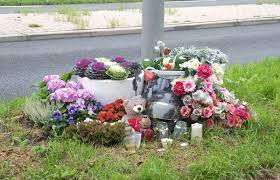
I am always in awe when I drive past roadside memorials. They commemorate the place where someone was killed in a motor vehicle crash. They grew in popularity following the of MADD, Mother’s Against Drunk Driving first in the 1980’s in Austin, Texas. These are usually a white cross along with trinkets, toys, and photos that memorialize them life or lives that were lost at the location. Many are painted with the names of people who have lost their lives too. What strikes me is who maintains the site? Is there any sort of memorial at a internment site? Do the same people who maintain the shrines also maintain a grave site?
There is a psychology to the roadside memorials that are dotted across our country’s roadways commemorating the lives of people who have perished. Usually these are simple crosses sometimes emboldened by the name or names of people who may have been in fatal accidents at the location. Others grow to become memorials to a lost love one and are maintained by grieving family members. I seem to see them everywhere and wonder about the survivors. Do they visit the site? It is different then a cemetery in that this is not the place where they were laid after death, but this is the last place on earth their loved one was alive.
I am reading a couple of books about roadside memorials with interest. One is a thesis from a Canadian university, authored by Holly Everett from Memorial University in Newfoundland. These sites are also known as the “spontaneous shrines” that result from a public outpouring of grief according Everett who studied the shrines in Texas as part of her graduate work. It makes me sad when someone builds a spontaneous shrine to honor the loss of someone. On my way to work a few months go, I noticed that 2 crosses were erected in a tree near my home. A spontaneous shrine.
While working as a police officer I noticed these spontaneous shrines popping up in our town usually after a fatal accident. Fortunately, we had very few fatal crashes in the 12 years I worked. Towns everywhere, including the one in which I patrolled, were discussing regulations about the roadside crosses and all the stuff that accumulated along with them. Our chief was sympathetic but the one or two shrines in our town became a traffic hazard in his mind. Cars (I assume family members or friends) would slow or stop for a short visit. We always worried about someone getting injured or killed on the site of one of the crosses. And we had a call to the cross on Rt 67. The boyfriend of one of the victims was sleeping at the cross site. Upon further investigation we learned that he was so grieved that he wanted to stay with the girlfriend’s cross one last time. Sadly, we had to send him along because having a sleeping person on a busy road caused too much public concern. Communities are needing to regulate these sites because the grieving public tends to add more and more to them. Some family members even mow grass or shovel snow keeping the site looking prosperous. According to the draft policy posted on the BBC site, “locations and content of roadside memorials will be vetted for safety and messages that can be considered “offensive” will be banned, as will any sort of illumination or materials that can shatter, such as glass” January, 2022
It struck me that the first names were imprinted on white crosses leaving off the last names of the two boys who died at the site. I would have liked to know the last names. I wanted offer my condolences in some way. Maybe I had seen them riding bikes in the neighborhood just recently, at least until one of them earned his driver’s license.
Intractable depression now has multiple options and hope for its resolution – read on
Intractable depression is something that occurs in 20-30 percent of patients with major depression. It is called treatment resistant depression or TRD according to Zhadanava M, Oilon, D,Ghelerter I, et al. (2021). There are more medications than ever and a range of programs for treatment resistant depression that some may not have heard about. For that reason this review will be useful.
As the name implies, treatment resistant depression is highly refractory to the typical treatments that generally include psychopharmacology and psychotherapy. I have had the clinical opportunity to meet with men and women in psychotherapy who are diagnosed with major depression but for some of them, nothing has helped. They have had multiple trials on numerous medications and psychotherapy with little to no relief of symptoms. Some describe a worsening of symptoms after beginning treatment and some claim this to be signs of an allergic reaction to the medication. The British Journal of General Practice has published a list of the first line antidepressants in 2019, Kendrick,Taylor, and Johnson. The meta analysis is conducted in 2019 revealed 21 medication’s that showed efficacy and tolerability in patients with it it may be depression. They found agomelatine, (Valdoxan), amitriptyline – a tricyclic antidepressant but is prescribed for various nerve, arthritis, and muscle pain, escitalopram (Lexapro) – may treat generalized anxiety as well as depression, mirtazapine (Remeron), used for poor sleep hygiene, failure to thrive, and major depression, paroxetine, (Paxil), venlafaxine, (Effexor) may help with GAD and panic anxiety, and vortioxetine (Trintellix) more effective than others.
These patients are intractable in their sadness and become resolute that nothing will help them. Most have been talkative, intellectually curious, but deeply sad in my presence. They are often hopeless that they may never feel a few moments of joy each day, no matter what they do. Many feel embarrassed for being so overwhelmed with life and barely hold on from week to week. Others take life with little hope that things will ever change and, for them, suicide is always on the drawing board. These few patients sometimes need a more structured living arrangement, usually a hospital. Many patients with intractable depression live life with their final exit all cued up and ready to roll. Some plan to move west to states like Oregon that has physician assisted suicide – saved for when they can no longer live with themselves. For these people, I work with them to find a greater purpose upon which to focus and measure success – often one day at a time. In addition to psychotherapy it is important to get these folks moving with rigorous exercise and activities to find greater purpose. Some patients decide to return to school, work or start attending church again. This programs not only enhance dopamine transport but they also result in social interpersonal contact, something many are missing as they grow older.
There are now new and controversial treatments for treatment resistant depression that are being reported in the psychiatric literature bringing hope to families everywhere. Treatment like transcranial magnetic stimulation, ketamine treatment, stellate ganglion block, deep brain stimulation (requires a surgical procedure to set a deep brain stimuator in the area of the brain that subserves the aura of well-being, and even psilocybin, a powerful psychedelic. Family members sometimes ask why can’t we do something less invasive? The transcranial magnestic procedure is non invasive and uses strong magnetic fields to stimulate neurons within the brain in the area that underlies mood regulation. Treatment requires 15-30 sessions. Readers may have heard little about these treatments, but for families who have watched their loved ones languish, they offer a modest hope that life for their loved ones now has options and promise. These are the cases that you worry about at the end of the day. These are the cases that may not buy what you are selling when it comes to a therapeutic modality or trial of medication that they have already tried and failed. The handoff to one of theses specialty options including ECT – electroconvulsive therapy needs to be a careful one and deep brain stimulation requires sensitivity and cautious optimism about the likelihood of success. A little halo affect can go a long way in getting a good first impression, and a good start to a new treatment modality. A careful history about what medications have been tried and failed is important to document including the length of time they took the drug.
Still newer is the return of hypnotic and synthetic therapy. Scientists are using psilocybin to bring patients through their depression in one of two treatments. Reader may understand that psilocybin are the main ingredients in LSD. There is a growing literature on the use of psilocybin to improve depression resistant cases. Those participating in psychedelic studies often say the experience was among the most meaningful of their lives, on a par with the birth of a child or death of a parent. Many report feeling a sense of connectedness with the universe. “This psilocybin journey was the single most transformative experience of my life,” Mr.Fernandez wrote in a medium post in 2018 reported in a recent NY Times opinion piece by Dana Smith, Ph.D (taken 7-16-2022).
I saw the 60 minutes story on SGB a year or two ago as a possible treatment for refractory PTSD. Many patients now matter how many medications the the and even combined with hours of individual psychotherapy still have reactive symptoms of the condition. SGB stands for Stellate Ganglion Block. Ganglion simply means a bundle of nerve fibers. We have numerous ganglia in our bodies. The Stellate ganglion is different and offers a potentially serendipitous treatment option for posttraumatic stress disorder (PTSD) that heretofore has been refractory to conventional psychiatric therapy. It may hold promise for co-occurring depression as well. It involves a neurochemical blockade of the stellate ganglion. The use of a small amount of anesthesia provides a risk free blockade of the autonomic nervous system overflow that contributes to the toxic levels stress hormones like adrenaline and cortisol that directly add to feelings of anxiety and hyperarousal among people with PTSD. This elevated arousal puts them on high alert night and day. This is not sustainable.
Here in Massachusetts, the MGH has a Stereotactic Functional Neurosurgery Program that among other things does SGB for medically intractable Obsessive-compulsive disorder and Major depression under a current protocol at MGH. Surgical options are not considered until when medical options are no longer effective or side effects may be severe (Functional Neurosurgery Program, Massachusetts General Hospital website, taken August 22, 2022. DBS has been utilized for Parkinson’s disorder for many years. For people who suffer with major depression many are hopeless and believe the world may be better without them in it. These alternative treatments like: ECT, TMS, Ketamine, stellate ganglion block, and DBS afford greater options at some personal cost. While they are intensive and in some cases invasive there is a trade off in terms of quality of life. The tipping point in my view, when people are isolated, hopeless, and their depression becomes a barrier to functional living, like failure to thrive, the cost of not taking a broad approach to treatment is too great. Human suffering can sometimes be so silent that no one takes notice. The treatment resistant are sometimes elderly and often alone. It is these people that I worry about in my practice as a clinician here in Massachusetts.
REFERENCES
Zhadanava M, Oilon, D,Ghelerter I, et al. (2021). The prevalence and national burden of treatment-resistant depression and major depressive disorder in the United States. Journal of Clinical Psychiatry; 82(2):20m13699
Kendrick, T, Taylor D, Johnson, C. (2019). Which first-line antidepressant? British Journal of General Practice; 69 (680): 114-115.
Smith, Dana (2022) Taking the Magic Out of Magic Mushrooms, Opinion, NY Times, July 16, 2022
Agin-Liebes GI, Malone T, Yalch MM, Mennenga SE, Ponté KL, Guss J, Bossis AP, Grigsby J, Fischer S, Ross S. (2020). Long-term follow-up of psilocybin-assisted psychotherapy for psychiatric and existential distress in patients with life-threatening cancer. J Psychopharmacol.Feb;34(2):155-166. doi: 10.1177/0269881119897615. Epub 2020 Jan 9. PMID: 31916890.
MGH (2022) Stereotactic Functional Neurosurgery Program, Website taken 8-22-2022.
Despite the public outcry for red flag warnings as a method of mitigating gun violence and high lethality shooting incidents there is no single repository for cataloging red flag behavior when red flags are observed. In some cases, red flags are ever present in a one-sided, authoritarian relationship slug fest. One man we investigated posed with a Remington shotgun in his high school yearbook. A real gun guy. Unfortunately, his gun obsession continued until the family had been murdered and he too would be victim to the last round of the Remington shotgun.
Think about how difficult it would be to track and classify all the red flags we see in people all the time. As psychologists, it is something we do regularly whether consciously or not. A dangerousness assessment is a component of every exam I do. If someone gives off signs that they may become violent, psychologists have a duty to warn potential victims and the local police. Who does the public call? Concerned citizens call police to do well-being checks almost daily – sometimes more than once. These are usually benign calls for service, but domestic violence and dangerousness require greater understanding of the risks of harm to LEO’s and innocent family members. It is a fact, that someone usually knows that there is imminent risk of violence – even mass murder, and does nothing.
“I thought he might do something, like kill himself or something, but I never thought he’d take the kids”
Sister of a Maine man who killed his family and then himself in 2011
States across the country are gearing up for red flag laws. As yet, there is no repository of “red flags.” People wrongly believe there is a single place where all violent intentions are stored. Yet no, social media is not yet advanced so as to trigger a warning when someone posts his plan to commit mass murder or other crimes. Violence suppression requires greater personal responsibility so that when a person becomes aware of a planned event, he or she must notify public safety officials. There is seemingly no red line, that if crossed, someone would be deemed too dangerous to own a weapon or perhaps be brought for early dangerousness assessment. In cases of domestic violence, there must a change in the conditions for bail. While bail should not be considered a punishment there are times when public safety must come first. The quotation above is from the psychological autopsy conducted after Steven Lake murdered his wife Amy and their two children in Dexter, Maine. Bail conditions were very low for Mr. Lake because he had no criminal record. In retrospect, his sister shared a premonition that her husband was dangerous, and it turned out to be true.
Red flags are the antemortem behaviors that indicate growing affective instability. These are suggestive of an increased level of risk to intimate partners and often the general public. They are the clues that behavioral scientists hand out whenever the topic of dangerousness is brought up – we are reminded of all the red flags. I think the American public is tired of hearing about red flags because so often they are present in the retrospective after the murder victims have been laid to rest. The prior depression, suicidal behavior, various forms of interpersonal violence, availability of firearms, forced sex, choking, pathological jealousy, violation of restraining order, and threats of death are a few red flag warnings often overlooked. We will speak about the Uvalde killer and a couple others in the next few paragraphs. But bear in mind, the best predictor of future behavior is past behavior.
Just as violent spouses manifest a behavioral purulence, mass shooters often display a similarly angry predilection that is posted on the their chosen social media platform in the form of a host of miserable, cantankerous resentments. This resentment can take many forms and is often the road map into the underpinning of their anger and growing desire for violent recompense. These are not monitored by the dangerousness police, in fact, red flags are not collected, tallied, or catalogued at all. If the ad hoc red flags are laid out and the subject suddenly comes into contact with law enforcement and all the planets align, then a high lethality event may be averted serendipitously one day. But derailing a mass casualty event on the front end has been an inauspicious foist at best. These shooters inevitably fall through the cracks and very few have been stopped in their tracks because of red flags that rose to the level of containment. How is that possible?
In 2016, the knee jerk reaction is to attribute the recent Thousand Oaks, CA nightclub shooting to a “crazed gunman” that would unfairly place the blame on the mentally ill. Psychological experts believe mentally ill persons lack the higher order planning to execute the complex steps necessary for anything more than petty crime – more often associated with co-morbid substance abuse. It is the co-occuring illness of drug or alcohol addiction that is a confounding variable in all police-mental health encounters. The interaction of substance abuse disease, like alcoholism or opioid abuse and mental illness is complex. Persons with drug and alcohol addiction must be expected to become sober with the help of substance abuse treatment and family support. The risk of violence and suicide declines when sobriety can be maintained. It goes up when depressed and angry men drink more than they should.
Some social media platforms use algorithms to predict when someone may use violence based upon target words, internet search terms, and photos that may be posted. So far, none of these have helped to intercept a shooter from his intended targets. In the aftermath of high profile mass shooting, law enforcement and the FBI uncover pages and pages of antisocial ranting, hostile embitterment, ethnic hatred, and angry beliefs along with veiled threats. These often are directed at one person or group of people who are perceived to have wronged the shooter. Virginia Tech killer Seung-Hui Cho send his diatribe to the media in 2007. In the case of Steven Lake, his daily online diatribe about the unfairness of the court order protection always drew dozens of ‘likes‘ and comments that he was a good father and should “fight for his children”. The fast action by the victim’s employer and the Dexter police on the morning of the murders is likely what prevented a rampage. It is believed that Lake had an intended list of people he planned to murder.
Some mass shooters are engaged in group chat rooms where messages of violence and hatred are shared, bringing their fetid ideas to the drawing board. In these chat rooms, like-minded antisocial men and women hoard their reactionary fantasies decayed by the never ending bluster and beset in a de facto life filled with anger and decreased empathy. Video games contribute to aggressive thoughts, feelings, and behavior in the laboratory and in life (Boffey, Dana Foundation). So among the cartoon characters in the chat rooms are young men who are searching for meaning behind the call to war or other video games. They collectively create a sense of having been the victim of injustices and being driven to seek vengeance against anyone he believed had wronged them” assuming no responsibility whatsoever, according to Peter Langman, 2017.
Each time a person strikes out in a mass shooting the people who are tasked with understanding and identifying red flags that were present signaling the impending violent combustion. These are often easy to spot by those closest to the shooter. The possibility of mandating the report red flags is being debated. Like child and elder abuse, proponents of red flag warnings want mandated reporting laws for persons with direct knowledge of violent intensions when it becomes known. “And when it comes to mass shootings, those with mental illness account for “less than 1 % of all yearly gun-related homicides” a 2016 study found. Other studies indicate that people with mental disorders account for just 3-5 % of overall violence in the US” – Paul Appelbaum, M.D. taken from BBC by Rachel Newer 11-1-2018.
In May, 2014, Elliot Rodger, 22, posted a YouTube video declaring his intention to slaughter “those with a good life”. Elliot felt like girls he had dated were unkind to him. He wrote a manifesto over over 100 pages. These pages detailed his childhood, family problems, his inability to get a girlfriend, and his hatred of women, ethnic minorities and interracial couples. And it contained his plans for a massacre according to Andrew Springer, journalist who interviewed Peter Rodger, Elliot’s father. This occurred in Santa Barbara, CA, where his murderous rampage was posted using social media sites as a prequel to the killing of 6 college students including his two room mates – one of whom he stabbed 94 times. His therapist made a valiant effort to warn the possible victims of his violent intentions as the law requires.
In a case of nihilistic violence, Vester Flanagan, a television news reportely killed a female colleague and her cameraman while live on the air. “Like dozens of mass killers before him, the shooter embodied a deadly mix of resentment, delusion, and thwarted aspiration” according to Sarah Kaplan (Washington Post, August 27, 2015). The live twitter posts, videotaping the shooting, and horrific execution of the victims by Vester Flanagan on live television will be a specter for years to come in Virginia’s Roanoke market. Just as important may be the analysis of Flangan’s devolving mental status in the months and days leading up to the terminal event.
The case in Uvalde, TX is similar in that the shooter set his sites on children and teachers. Ostensibly, selecting a soft target to amplify his intent on bringing forth chaos, pain, and historic violence, like the Sandy Hook, CT killings in 2012 and Stoneham Douglas High School in Florida. Much of the aftermath scrutiny of the event will catalogue his social media presence and its potential for understanding what triggered the despicable attack and may have informed law enforcement about potential for exploding embitterment through violence. And the police response in this event remains under investigation because of the poorly executed breach and termination of the event. No one knows how long James Ramos may have exuded his intention when he purchased two AR-15 style rifles just days after he turned 18. One could infer that his plan was hatched months before given the timing of his gun purchases. Dr. Peter Langman described an accumulation of real or imagined injustices among the causal attributes of such gun violence as Uvalde, Sandy Hook, and so many others. Shooters are deeply driven to seek vengeance against anyone they believed had “wronged” them according to Langman in 2017. Interestingly, video game violence has not risen to the top of the list as a leading cause of mass killing although, “Violent video games provide a forum for learning and practicing aggressive solutions to conflict situations,” Anderson 2000.
Let us look at the most recent event in July 2022 where Robert Crimo III, known as Bobby, climbed to the roof of a structure overlooking the start of the July 4 parade in Highland Park, IL. He had a semiautomatic AR-15 style rifle that he legally purchased himself. And yet, in November 2019, police were called to his home because he was threatening to “kill everyone in his family”. He had the means and the mindset for such a crime that the Highland Park police removed 16 knives and a sword from his home in his possession. These were returned to him sometime later. In 2021, they were called to the home once again for now-18-year old named Bobby, who wanted to kill himself. The same person. In the Chicago Post interview, the senior Crimo downplayed his son, Bobby’s threats in that incident as a “childish outburst.” Not quite right. The red flags were there and if a red flag repository existed, he should not have been allowed to purchase or poses firearms. Whether or not he should have been contained in a mental health treatment facility is not known.
Containment of violent offenders is an important component of the criminal justice system. But what about those who are exhibiting red flags? Containment of violent citizens is also something to consider before they act on violent impulses. How do we protect their individual right to privacy? Someone usually knows what is likely to happen if something isn’t done to break the cycle of coercion and violence. In the Dexter case the killer’s sister knew. 12 hours before the murders she told her brother to “go get help”. But he could not. He was a gun guy. The fact that so many mass shooters are killed by law enforcement or kill themselves prevents analysis of broad psychological factors that may have triggered the terminal rage such as early childhood instability, loss of a love object, hostile embitterment, or a desire for blazing masculinity. And those who are captured such as James Holmes who was convicted of the 2012 Aurora, Colorado theater shooting in 2015. There was nothing that could be cited that correlated with the extent of violence and victims from that night in Aurora – 12 fatal and over 40 with severe injuries. A quick review reminds us that Holmes was a bright doctoral candidate in neuroscience prior to the massacre. “Studies have shown study that exposure to violent video games is positively related to adolescent aggression; however, normative beliefs about aggression have a mediating effect on exposure to violent video games and adolescent aggression, while the family environment regulates the first part of the mediation process.” In general, the research has not consistently supported the notion that violent video games contribute to aggressive behavior or mass shootings but some have offered modest correlation without espousing causality. Massachusetts has recently enacted an emergency red flag for people who are exhibiting the most violent behavior. It allows police to remove firearms and revoke a person’s license to carry a firearm. Known as the Extreme Risk Protection Order (ERPO), also known as a red flag law, is an order from a judge that suspends a person’s license to possess or carry a gun. That said, greater emphasis on the assessment dangerousness, along with mandated reporting just like in suspected cases of child or elder abuse and a DV offender registry may be worth considering. It is not an exact science but in case after case there are undeniable red flags and someone who knows what is going to happen because of an intimate and shared relationship. Look at the red flags and make a determination of risk. Containment including: no bail holds, loss of second amendment privilege, and GPS monitoring will instill greater responsibility in both violent citizens and shared criminal responsibility with those keeping the dangerous secret.
Anderson, C, Dill, K, (2000), Video games and aggressive thoughts, feelings, and behavior in the laboratory and in life. Journal of Personality and Social Psychology, Vol. 78, No. 4.
Anderson, C. A., and Carnagey, N. L. (2014). “The role of theory in the study of media violence: the general aggression model” in Media violence and children. ed. Gentile, D. A. (Westport, CT: Praeger), 103–133.
Boffey, P (2019) Do Violent Video Games Lead to Violence? Dana Foundation, Neuroethics Viewpoint.
It is well known that law enforcement can be called to the homes of domestic violence victims only one in seven occurrences of abuse. That means there are possibly 6 times when victims are traumatized by intimate partners to which LEO’s are not privy. Why is this? In my experience, perpetrators of intimate partner abuse are secretive and forbid their partners to call police. They are manipulative and want to control the interview such as when first contacted by law enforcement. They frequently act surprised that police were called sometime saying “are you sure you are at the right place?” But in reality they silently simmer, waiting for police to take the bait and run. Often back on their spouse as soon as they are alone. The entire basis for the relationship is all about coercion and control of one spouse over another. It all starts as secret manipulation fueled by jealousy and insecurity.
Many victims of DV are coerced to feel afraid of calling for help. Police need to see all members of a household when called to a case of domestic assault. This bullying by perpetrators results in a pattern of threatening and control that is coercive to victims who learn to remain silent, in spite of fears of being killed. Red flags are often missed with the arrival of police officers as intimate partners pull it together trying to avoid angering their tormentors who control by making veiled threats. These investigations sometimes require more than one visit.
Follow-up intervention is recommended once the dust settles. This is sometimes hard to achieve. Whenever an aggressor is taken to jail, whether for the night or weekend, contingencies for his safe re-entry must be negotiated. When the risks to spouse or family members remains elevated, then an order of protection should come together based on the details of the call and written so as to bring to life all documented red flags. Either way, the investigation is not completed until there is an understanding of what happened (why the police were called) and what comes next for this couple? Specific issues like: threats of death, forced sexual contact, physical abuse leaving marks, any kind of strangulation, threats with a firearm or other deadly weapon, and threats of suicide are all the details written into a protective order. These are big ticket items and raise a victim’s level of risk substantially and usually become part of a stay away order. Each of these crimes are a red flag warning to cops looking at charges for domestic violence.
Larger departments across the United States have experienced greater numbers of domestic violence since the initial quarantine in 2020. As the months went on adaptive coping broke down resulting in larger numbers of domestic violence with maladaptive coping behaviors such as: excessive use of alcohol, threats of physical violence, frustration, and boredom increased greatly. Some, like Portland, OR actually saw a reduction in officers assigned to the DVERT – the multidisciplinary unit that investigates DV in Multnomah, County, Oregon in which Portland is the County seat.
The Portland (OR) Police Bureau’s Domestic Violence Enhanced Response Team (DVERT) and Domestic Violence Reduction Unit (DVRU) have been reduced in manpower according to information poached from their website. They now have about half the number of officers they did 10 years ago – five officers assigned to the DVRU and two officers plus a Multnomah County Sheriff Office detective assigned to DVERT according to a 2015 Blog post written by Emily Green. With this staffing level, they have the resources to investigate only about 7 percent of domestic violence reports received by the department each year. In 2013, out of a total of 8,179 domestic violence reports, only the 586 most serious cases were assigned to the domestic violence unit. DVERT strives for a “best practices” model of interagency collaboration by coordinating several forms of intervention for domestic violence victims and offenders as reported on the department website. As of this writing no more recent numbers are available.
Isolation of victims from family
Other cities struggle with DV and its social fallout. In 2017, San Diego law enforcement received 17,306 reports of domestic violence. This number was four percent higher than the previous year, according to the Criminal Justice Research Division. There were eight domestic violence-related homicides in 2017 that involved current or former intimate partners. Domestic violence incidents involved a death in four other instances. Five domestic violence offenders killed themselves according to a domestic violence blog maintained by a local attorney in San Diego. Likewise, San Diego saw changes in the rate of DV during and after the pandemic. The Alliance for Hope in San Diego provides support for police investigating crimes such as strangulation with supportive end empathic care for victims of domestic assault.
I wrote about #24hourwindow project in my description of the Icelandic response to DV in Rejkavik and beyond. Police in Reykjavik, Iceland believe that detectives or senior police officers must intervene within the window – 24 hours from start of a call out, to put together a strong case and collect evidence. I agree with this approach and strongly urge local agencies use it as a model. They work in teams of 4 or 5 as described in a BBC story. The former protocol was often several days after the call and coincided with the honeymoon period where violent partners try and kiss and make-up. Bail conditions frequently fail DV victims as the abuser is often bailed out within 1-2 hours. Egregious cases of DV, those particularly life threatening should be held without bail until a dangerousness hearing may be initiated.
To the un-trauma-informed investigator, many behaviors exhibited by someone who’s just experienced a traumatic event double as signs of lying. Behaviors such as an inability to remember the chronological order of events, nervousness, avoiding eye contact or of recalling sounds and smells with more ease than physical details about his or her attacker, are all the result of effects trauma has on the brain.
Emily Green 2015
Specially trained Portland (OR) Police Officers review and follow up on reported incidents of domestic violence. Their responsibilities include reviewing reports from the initial responding officers, assessing each case in order to prioritize incidents requiring follow-up investigation, making attempts to contact the victims and witnesses to obtain additional information, providing referrals to victims for appropriate services, and attempting to contact and arrest perpetrators of domestic violence. This should be done during an 8-10 hour shift or by the next regular day shift by law enforcement who understand intimate partner abuse and its dysfunctional, cycling nature.
“In Iceland, twice as many women are reporting incidents of domestic violence to the police than they were two years ago. I wrote about this a couple months ago and had reached out to the #windowproject @IslForce and the #Rejkavikpolice commander without much fanfare. Like Portland Oregon, Iceland uses a multidisciplinary unit that enters the case in call-out fashion by each discipline rolling on scene called the 24 hour window project. This is due to an ongoing police initiative to provide women with better-timed and better-located assistance, which is bringing the problem out of the shadows” as reported in apolitical in 2017. I have called for regular aftermath follow-up in cases of domestic violence as a form of community policing. Officers work in pairs and stop during the next day to complete a check-in. Some victims are contacted by their abusers or family of the abuser and can be dissuaded or intimidated not to press charges. This resumes the honeymoon and cycle of violence is renewed.
There were times that at the end of a midnight shift in Westbrook, Maine, outside Portland, and New Braintree PD, in Massachusetts that I had reports to write for incidents I had been assigned during the shift. More than once, I snuck out of the patrol office and went home – too tired to write. And more then once, the sleep I so wanted was disturbed by the day sergeant or court officer looking for my report. Or sometimes, when I did stay, my writing was not my best effort because I was tired. Report writing is an art and is now a large part of both the academy training and field training programs. Law enforcement officers are better trained and more highly educated than ever which is essential in these times where every word is public property. The media, the citizenry, and the police hierarchy are all slicing and dicing every paragraph of today’s reports looking for your mistakes, it seems. The reason I write this is that police reports have consequences and if important statements, or officer observations, or photographs are omitted, cases may be lost. It is essential that report writing be taken seriously because, in the setting of domestic violence, lives depend on it.
Just like any report document that is to be handed out to anyone who might request it, particularly underpaid defense attorneys who swim in circles, like sharks looking to devour a poorly written report and its author. Report writing needs to be concise and laser focused. Particularly important is the reason for the call. Why did this victim call today? We know that the abuse tends to escalate successively. Sometimes, it is only when children become involved that a victim will move to stop the violence. In Vermont, a teen boy shot and killed his father when the man drunkenly waved a pistol threatening the family. And in Maine, a 13 year old boy was found to be hiding a 20 gauge shotgun and ammunition on the day he and his family were murdered by his father Steven Lake. Our analysis of the Maine case led us to understand that the boy was likely intending to defend his mother and sister against a violent and unpredictable father. He may have been seeking to load the weapon when his father snuck into the unlocked house and overpowered the family. 20 gauge shells were found in the child’s bed and under his pillow.
Image from Mobile ODT
When conducting assessments or forensic exams with a victim of domestic violence (DV), any reported history of strangulation places the person at a higher risk for more serious violence or homicide by the hands of their intimate partner. By recognizing signs of strangulation, healthcare providers can help to mitigate long-term damage, properly document any evidence of abuse, and provide referrals for seeking safety assistance. Sara Vehling 2019
Risk assessment tools provide quantifiable data that may be used to develop actuarial projections as to degree of risk and dangerousness. Report writing now should include assessment tools that uncover potential risk to victims. Jacqueline Campbell, RN has a valid risk assessment tool for determining whether there is high risk to potential victims that can be living in the home while officers are still on scene. Campbell’s work is readily available in the DV literature and known to most of us. The Ontario group in Canada also has a reliable tool – ODARA used by law enforcement agencies across the country. In my agency we adopted both tools after the research was complete from The Maine homicides. The national leadership includes Lenore Walker, in addition to Campbell, who both have published a good deal over 25 years on DV and its cycle. Walker believes that women and families are exposed to great harm when the abuser is out of jail only hours after terrorizing his family. It rarely mitigated the next beating.
I propose holding the abuser until his first arraignment perhaps as long as 2 days. This allows for a cooling off period. Minutes are like hours while sitting in a municipal cell block often eating fast food 3 times a day. But the 8th Amendment of the Constitution guarantees that bail shall not be unfairly denied or excessively harsh. In truth, the modification of bail conditions in some instances must be done in real time to account for the severity of individual cases of DV and unique red flags. Experts have said that when a victims says ”I know he is going to kill me” then there is a greater likelihood that she may be correct and a protective, safety plan should be put in place. On the continuum of risk, expecting to be killed is only slightly less dangerous as physical attempt to kill or maim. In these most dangerous cases, there are tactical measures that must be written into protective orders such as GPS monitoring, forfeited bail and remand to custody for violation of protective orders, social media restriction, no contact with victim and children, no contact with victim’s family or friends, and supervised visitation, when only appropriate. It is these cases where the police officer’s report must be first rate and bullet proof.
A period of being held in custody until initial arraignment will enhance public safety and public trust in the short run. If applied to all persons arrested because of domestic abuse, then it would not unfairly impact only the poor or disenfranchised. Abuser’s should not be able to buy their way out of jail nor should they be free to wander their communities stalking their supposed loved ones. Steven Lake who killed his family and himself in Dexter, Maine posted his love for his children nightly and had piteous social media “friends” encouraging him to “fight for his children”. Little did they know he was planning the onerous events that would end the Lake family timeline forever. The Maine Law Review in 2012 reviewed changes in conditions of bail and cited our research over 12 times in its review of conditions for the release of persons in jail for domestic violence. Protective factors include the abuser having full employment and a substance free environment.
As the reader begins to understand report writing requires a visceral response and poignant understanding of this hidden social maelstrom. There are legitimate reasons for seeking “no bail” holds on some people arrested for domestic violence when high acuity and high risk exist together. These have been posted by me in the Human Behavior blog.
Campbell, J. (1995). Assessing dangerousness. Newbury Park: Sage. Nicole R.
Domestic violence homicide shares common red flag warnings that are discernible when prosecutors take time to connect the dots.
In Maine, Texas, and across America, the criminal justice system – including prosecutors, too often fail to protect victims of domestic and family violence from their abusers — even when the “red flag” warning signs are obvious as they were in both these cases. In this post, and the March 15 post, I talk about the importance of report writing and truly understanding DV on a visceral or gut level. To truly understand what is going to happen requires a realization that just below the surface may lie a wolf in sheep’s clothing.
In early 2021, the police in Austin,Texas were beset by a horrific case of domestic violence homicide. On April 18, 2021, a former police officer killed the family while picking up his son for a monthly supervised visit. The child’s mother encouraged these visits as important to the boy’s development and relationship with his violent and sadistic father. While exchanging pleasantries, the child’s father shot and killed his former wife and step-daughter. And he killed his daughter’s young boy friend and immediately fled. Detective Broderick was captured 20 hours later and is being held. Yes, the abused was a former law enforcement officer.
Common sense look at facts
Police need broad discretionary authority in dealing with any violation of orders of protection including no bail holds and danger risk assessment
Following the 2020 arrest for sexual assault of a child, Broderick resigned from the Travis County Sheriff’s Department. He was initially held on $100,000 bond. A family friend remarked, “I kind of had a feeling that this is where he was going, because he was lost,” she explained. “He lost everything. He lost his family. There was a protective order for a reason.” He was lost? That gives him the right to violently kill his former wife, adopted daughter, and her male friend? Many in our society are lost and do not go on to commit violent homicide.
The 16-year old child, who was among the victims, begged for a more restrictive supervision of her step-father who had been released from jail and was not required to wear an ankle bracelet after only a period of 3 months. An order of protection was brought against former police detective. There was a protection order in place but even the teen knew that orders of protection were “not worth the paper they were written on.”
“Because Mr. Broderick committed this heinous crime after he paid a money bond to be released on charges related to sexual assault against a child, Texas law permits his detention without bail.”
Wes Wilson, KXAN television Austin, TX
There is a case to be made for careful analysis of behavioral health functioning of abusers. That seems to be common sense right? But this sometimes does not occur. As a law enforcement officer in Massachusetts, I made an effort to introduce risk assessment tools to quantify a subject’s dangerousness. This is important but is not yet universally adopted here in Massachusetts. Nearly 10 years on, the psychological autopsy conducted in 2011, looked at the red flag warnings that are common to DVH everywhere – including the case in Austin. What brought my attention to the case in Maine was the purported prosecutorial impotence argued by Christopher Almy, the county district attorney, that there was “nothing that could be done to protect the victim, Amy Lake and her two children, from her estranged husband Stephen Lake. That statement was inspiring. Imagine if you and your family were depending upon the police to protect you as Amy Lake was? Everything that could be done was in place. But the protection order had no teeth. So Steven Lake snuck into the Amy’s home at 5 AM and staged a despicable murder scene, ultimately killing the children he claimed to love while Amy was forced to watch. Ending with her shotgun murder and is own death by suicide.
“Domestic violence is not random and unpredictable. There are red flags that trigger the emotional undulation that bears energy like the movement of tectonic plates beneath the sea.”Michael Sefton (2016)
In an article on the 8th Amendment regarding bail in cases of domestic violence, the Maine Law Review, first in 2012 and an updated second publication in 2017, cited the importance of carefully crafted conditions of bail especially among men who are found to have violated the conditions often by stalking and using social media to intimidate and contact potential victims also by trolling family members in an effort to locate estranged spouse and her children who may be in hiding. Both Amy Lake and Austin, TX mother of 3 expressed an interest in having children remain in contact with extended family in spite of pending serious criminal charges. This opened up access to the perpetrator to information about current living arrangements, employment, after school activities, and other potential clues that raised the risk of further domestic violence and ultimately DVH. In Austin, the victim expressed a wish to allow her estranged husband to have contact with the little boy – his son in spite of pending felony charges brought forth by the 16-year old step-daughter who rightfully feared for her life. Why was her fear ignored or minimized given her history of having been sexually assaulted by her adoptive father and his animosity toward her for reporting the abuse to law enforcement. He blamed her for his loss of career and status as a local detective with the Travis County Sheriff’s Department.
Firearms are a major cause of DVH and in every state are required to be taken from men with active protection orders in place. This was the default expectation in the two cases described here but in the case of Stephen Lake his arsenal of 22 firearms were not removed from his possession in spite of court orders. Similarly, the Austin killer was left with at least one firearm used to kill his family. Lake left 9 suicide notes many of which were rambling, angry tirades toward his wife and in laws. The Austin killer did not take his own life and was captured. This is atypical especially among law enforcement officers raising the specter of possible psychological analysis of his motives. This make the two cases in this post very different at this level. To what extent Texas authorities will endeavor to understand the events that preceded the murders remains unclear although, like the Aurora theater shooting, having a bad guy to study is rare. This means nothing, aside from an opportunity for personality and psyhopathology to be brought up at trial perhaps allowing Mr Broderick to avoid death row. There is not much in the public media since the crime and his capture. However, gaining a comprehensive understanding of the red flag warnings in this case is recommended and will add to the body of literature on domestic violence. Why he chose not to kill himself is itself a mystery.
Domestic violence homicide risk factors
Threatens to kill spouse if she leaves him – pathological jealousy
Actual use of firearm or other weapon anytime during domestic violence incident
Access to firearms even if he never used them – veiled threats
Attempt at strangulation ever during fight
Forced sex anytime during relationship
Unemployment of perpetrator
Stalking via social media – one or both spouse use social media to intimidate or garner support
Presence of unrelated “step” child in home
Spouse finds new relationship soon after separating
Low bail release from custody – high bail holds are essential in DVH mitigation
The 8th Amendment guarantees that people will not be faced with unfair conditions while in custody nor should they have undue hardship following adjudication. But when victim safety requires it then some modification of this rule must be considered. Dangerousness to possible victims requires some abusive subjects (usually men) be held without opportunity for bail at least as long as it takes to confirm that there is no immediate danger to possible family members. This evaluation sometimes takes hours to days to complete. In Massachusetts, here in the US, some courts have court clinics that can assess persons in custody for risk of suicide and dangerousness. The pandemic has reduced this option significantly and arraignments were conducted virtually for months. Many district courts work with domestic violence agencies on a regular basis sometimes in the court buildings near court rooms.
Maine Law Review
Not much has changed since the Maine Law Review cited our work in its 2012 in Nicole Bissonnette’s review of bail conditions following domestic violence. Ms. Bissonnette published second paper in 2017, in the same MAINE Law Review that gives some quick and easy fixes for the 8th Amendment conundrum as it pertains to domestic violence. It is a fact that victims generally do not call police when the abuse first begins. It is also a fact that if a victim has been threatened with death if she “leaves” or “asks for a divorce” then her risk is substantially elevated and a safety plan must be provided including an order of protection.
The 8th amendment guarantees that excessive bail nor excessive fines shall not be required when someone is in custody and when found guilty of a crime. In many cases of domestic violence assault, abusive spouses are released on personal recognizance – essentially no bail is taken. Abusers are required to show-up on the next court day (usually Monday morning) and answer to charges of assault, domestic abuse, or whatever the evidence shows. The 8th Amendment also specifies that punishment for crimes shall not be excessive, overly punitive or harsh. It is frequent that abusers may have no criminal record whatsoever. Given that fact, it is hard to argue for high bail in a case where the defendant is unlikely to skip out on an initial hearing. This is precisely the reason why officer reports must include detailed statements from victims and witnesses – especially children.
I agree in principle that bail should not be punitive but neither should a family be faced with constant fear and danger because of the arrogant defiance of an abusive spouse. People without means do not have money for bail and some individuals are unfairly kept in jail simply because they or their families do not have cash for release from custody. So, a person who may be unemployed and was picked up for shoplifting and has 2 prior arrests may have an artificially high bail so he sits for weeks in a county jail awaiting trial. There are times when dangerous supersedes the right to be released from custody. This requires close scrutiny for making bail conditions that reflect risk to community and red flags for individual families.
In the 2017 Maine Law Review, Nicole Bissonnette restated her 2012 premise that bail conditions must be considered carefully when it comes to letting violent intimate partners out of custody. Ms.Bissonnette smartly cited the work done by this author and colleagues that brought these issues into sharp focus (Allanach et al. 2012). The importance of orders of protection cannot be understated in preventing domestic violence homicide. “The purpose of this follow-up comment is to evaluate the existing (PFA) system and assess methods of improving outcomes while avoiding prohibitive fiscal impacts” according to Ms. Bissonnete, 2017. The process, structure and failings of the existing system will be illustrated by the tragic deaths of Amy Lake and her two children, who were murdered by Steven Lake, despite the PFA in effect at the time. It was this case that brought domestic violence homicide into national prominence and provided substantive recommendations for mitigating DVH. Information is often unavailable to bail clerks or even judges when PFA’s are needed most. Information such as whether the defendant has previously violated conditions of release, probation or other orders, including, but not limited to, violating protection from abuse orders according to Jennifer Thompson, 2004. When these factors are affirmed then bail conditions must be revised in real time accordingly. Substantial bail for violation of protective orders is but one of them. Some believe that having non-refundable, very high bail is the only sanction to prevent recurring violations of the PFA. The 8th Amendment informs that bail may not unfairly impact people without employment and those who do not have financial means to buy there way out of jail.
There are cases, as recently as 2021 where a protection order was denied and domestic violence escalated into death of the New Hampshire suspect and critical injuries to intimate partner who became the victim. A judge did not think a protective order was warranted. Similarly, in Austin, TX, a disgraced police officer shot and killed his step-daughter, the teen’s boyfriend and his former wife in April 2021, even after the teenage girl begged for a protective order with the option to hold the abuser in jail. Her fear was palpable. The shooter was required to wear an ankle bracelet for 90 days after which he was free to stalk his former family who were trying to move on. There were several flaws in the safety plan in this case that ultimately triggered the terminal event such as coming together for planned visitation so the former police officer could visit his son who was not murdered. In New Hampshire, a judge denied a protective order on the basis that the abuser had not been violent since 2016 although acknowledged that the man was coercive and controlling. The victim, Lindsay Smith, was shot and critically wounded in Salem, MA in November 2021. Her former boyfriend, who had stalked the victim for the years since the break-up reportedly said he intended to forever “turn her life upside down” died from a self-inflicted gunshot wound. This may have been avoided if the temporary restraining that had expired had been approved to become a permanent restraining order as the victim had petitioned.
The desire to mitigate police discretion in domestic violence cases stems, in part, from problems relating to “the inherent ambiguity of the police-citizen encounter in the context of domestic violence.”
Jennifer Thompson, 2004 Maine Law Review
The domestic violence literature suggests that after 5-7 beatings victims will reluctantly summon police – especially if they fear either they or their children are about to be murdered. The details Calais, ME case of domestic violence are being carefully guarded even today. It is known that Daniel Phinney, 26 was out on bail after being arrested and charged with domestic violence and criminal threatening in May 2013. At that point he must have both physically assaulted his significant other and threatened to kill or maim his family resulting in the charge of criminal threatening. Police are quick to say that Phinney had “no prior criminal history” perhaps in an effort to obfuscate public outrage evoked by the system of bail in Maine that releases violent abusers over and over again on low bail. Had anyone made an effort to determine the degree of risk posed by Daniel Phinney prior to his release? Had anyone registered safety concerns based on the defendant’s behavior and history? If there had been routine aftermath follow-up then this may have been a known fact. A psychological assessment of Phinney may have provided important details about his impulse control, substance use, coping skill, and proclivity toward violence and had been charged previously with domestic violence. Phinney was killed by police in a stand-off in Calais, Maine shortly after being released from custody.
The case is reminiscent of the 2011 Steven Lake homicide in Dexter. Lake had twice been released on bail before murdering his family. The medical autopsy concluded that “in spite of psychological counseling (the state) failed to appreciate the degree of anger and violence in Steven Lake”. He had also been charged with criminal threatening after holding his family at gunpoint as he drove home the point about how much he loved them but he could not let Amy move on.
Using a firearm in the commission of a domestic violence incident is defacto evidence of dangerousness and no bail shall be considered until such time as all firearms are collected and a viable safety plan is in place for potential victims including police protection.
Michael Sefton, Ph.D. 2021
I was a member of a team that conducted a psychological autopsy on Steven Lake that resulted in over 50 recommendations to the esteemed Maine Attorney General’s Homicide Review panel in November 2012. At first glance there appears to be brash indifference toward the court protection order and the failure to remove firearms held by the defendant. It is now important to study the case of Daniel Phinney and others, so we ma learn from the many red flags exhibited in the weeks prior to his death. These red flag events must lead to stopping and containments points in future cases of domestic violence and domestic violence homicide. No family should be kept in fear by a spouse whose loathsome behavior derails all human spirit and sense of dignity.
At what point does the well-being of victims and potential victims rise above the abuser’s right to bail?
Michael Sefton, 2014 on the 8th Amendment and PFA orders
Bissonnette, NR (2012). Domestic Violence and Enforcement of Protection from Abuse Orders: Simple
Fixes to Help Prevent Intra-Family Homicide, 65 Me. L. Rev. 287. Available at: https://digitalcommons.mainelaw.maine.edu/mlr/vol65/iss1/12
Thompson, J (2004). Who’s Afraid of Judicial Activism? Reconceptualizing a Traditional Paradigm in the Context of Specialized Domestic Violence Court Programs, 56 Me. L. Rev. 407.
This video is about an introduction to a post that will be forthcoming in a short while it is reference to law enforcement officers and the suicide death of officers who carry trauma.
The NYPD is making use of psychological autopsies, a research-based approach that attempts to better understand why someone took his or her life.
The fight/flight mechanism that keeps us on guard plays a primary role on how people feel after episodes of high stress. Feelings of frustration, lack of focus, chronic fatigue, and even depression can result from an over reliance social media stimuli like an unfed addiction.
Members of Direct Decision Institute in Chicago (right)
The multiple deaths by suicide have renewed attention on another troubling and often hidden issue: Police officers die by their own hands at rates greater than people in other occupations, according to a report compiled by the Police Executive Research Forum (PERF) in 2019, after at least nine New York City police officers died by suicide that year. I was involved in the April 2019 presentation at 1 Police Plaza on the impact of LEO suicide as it related to the high incidence of police officer death by suicide according to Sefton in 2022.
In Iceland, the first 24 hours after a report of domestic violence, the window of opportunity is open. During this window there is multidisciplinary response from police, social work, legal experts, and from the child protective service that establishes a safety plan and targets supporting the victim from her household, and sometimes away from the dangerous intimate partner.The first 24 hours after the report comes in is critical. Victims are more likely to accept help if definitive, comprehensive assistance can be offered right away. Within the window of emotional opportunity.
The Iceland Project puts together the package needed to bring charges by having a team of social service and law enforcement investigators who work together during the “call out”. One reason cases of domestic abuse seldom make it to court is because days and days go by before investigators can interview the victims. Some go to work, and some do not make themselves available to officers. “In Iceland, twice as many women are reporting incidents of domestic violence to the police than they were two years ago. This is due to an ongoing police initiative to provide women with better-timed and better-located assistance, which is bringing the problem out of the shadows” as reported in apolitical in 2017. I have called for regular aftermath follow-up in cases of domestic violence as a form of community policing. Officers work in pairs and stop during the next day to complete a check-in. Victims are contacted by their abusers or the family of the abuser or may be harassed via social media and made to feel like it is their fault this occurred. I had one victim tell me she was beaten up by her husband because the dinner she had prepared was late and unsatisfactory. I stayed in contact with her until the family quickly sold their home and moved from the area. That is pretty typical whereas the abusive partner wants to keep his wife under control. As soon as she makes friends he moves her somewhere else. Even if he takes a different job. Cases of domestic violence here in the United States skyrocketed during the pandemic quarantine that also gave birth to new higher rates of substance abuse and changes in behavioral health and well-being.
Police in Reykjavik, Iceland believe that detectives or senior police officers must intervene within the window – 24 hours from start of a call out, to put together a strong case and collect evidence. They work in teams of 4 or 5. The former protocol was often several days after the call and coincided with the honeymoon period. Bail conditions frequently fail DV victims as the abuser is often bailed out within 1-2 hours. Egregious cases of DV should be held without bail until a dangerousness hearing may be initiated. The result of this usually resulted in cases being dropped and victims staying in dangerous relationships. In theory, victims are more likely to accept support and provide meaningful evidence in the first 24 hours after their abuse. The window program is designed to link victims with programs such as housing, psychotherapy, job assistance, and financial means for a new start.
The Iceland Window Project also offers perpetrators the same assistance and supports that victims receive. Charges against perpetrators of abuse have gone from approximately 24 percent of cases to approximately 30 percent of cases. This is a modest improvement at best, according to the BBC podcast People Fixing the World who report that caseloads have increased dramatically since 2014. In spite of modest changes in prosecution numbers the Window Project’s fundamental aim is to reduce intimate partner abuse. It is a well designed project to support victims and keep them focused on the problem. Many practitioners believe that when a family is in crisis, such as when police are called to the residence, that great change is possible. There has been some movement toward prosecuting abusers even when the victim changes her mind. This is a primary reason for the Window Project’s success. By getting statements, photos, and other evidence there is greater likelihood that cases can go to court even when the victim chooses not to prosecute police are now doing this on behalf of bullied partner/victims. Children who are exposed to severe domestic violence are more likely to go on and become victims going forward. Or worse, they grow up and do exactly what their abuser did.
Here in the United States victims of domestic abuse are at great risk. Especially as they prepare to leave their abusive partners. Law enforcement is required to arrest perpetrators of DV whenever signs of physical trauma. That is generally understood by the police and the abusive spouses. But what happens just as frequently, law enforcement officers send the abuser away for the night or weekend. This makes things worse for victims and children.







 MSefton's Human Behavior Blog