Domestic Violence Review – When Containment Fails
WESTBOROUGH, MA February 15, 2018 The fact is that greater containment of high risk abusers is needed. I have spoken with police chiefs, district attorneys, and state senators here is Massachusetts about conditions of bail. Whenever someone is arrested he or she is given the opportunity for bail – usually on his own recognizance. This means he simply promises to show up for his initial court hearing usually in the next 24-48 hours. Unfortunately, no one seems to believe that a person can be held on “high bail” simply because one subject held his family hostage and threatened them with a firearm or another person tried to strangle his intimate partner.
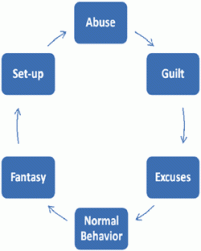
Power and control – Cycle of abuse
The system of bail is directly related to a defendant’s prior history of crimes, convictions, and lastly, the nature of the crime for which he is seeking bail. The cycle of abuse is posted to the left. It is all about power and control of the victim. On average, police are called after 9 prior episodes of abuse. In general, they arrive when the couple is in crisis and he may be feeling guilt and making excuses for his behavior. Or other times, the couple is in the honeymoon phase of the cycle and one partner invariably refuses to press charges on his partner. This is what really infuriates police officers called upon to answer these potentially violent calls. “It was all a big misunderstanding” according to the dangerous partner.
I have posted several essays over the years on the topic of “dangerousness” in terms of it being considered prior to the granting of bail. The June 2011 case in Maine culminated after the abuser was released from jail on $ 2000 dollars bail. After his death the money was returned to his family. Some district attorneys have tried to withhold bail money when the defendant fails to appear in court due to death by suicide after domestic violence homicide (DVH). For many this seemed like a draconian response to families who were in pain and suffering immeasurable.
“Many believe there is a disconnect between the judiciary and the bail system.” Sefton, 2011
What can be done to assure greater containment?
 WESTBOROUGH, MA January 21, 2018 Do people just “snap”? Rarely according to most literature I have read and published. The expression of violence is elicited slowly following a prolonged period of marginalized aloneness along with underlying resentment and anger according to Michael Sefton, Ph.D. This takes a great toll on relationships, loss of trust and a growing persecutory narrative that may become delusional. The gunman in the Las Vegas mass homicide was described as narcissistic – a personality disorder vulnerable perceived rejection or disrespect often resulting in sudden rage, denial, decreased rational thinking, accusatory blaming, and often marked denial of responsibility. In the Las Vegas shooting it has been learned that the gunman had recently sustained a significant financial loss although its link to the people he killed remains a mystery. There is typically some specific event that may trigger a violent event that could have been planned over months or years and evolve like the expression of some genetic permutation.
 is neither the reality nor the underlying cause of terminal rage. In light of the information being uncovered about the Newtown, CT mass murderer, the specter of mental illness insures a convenient scapegoat. Updated information from Newtown recently confirmed that Adam Lanza had studied the media stories of prior mass killings as he planned for his despicable finale. In retrospect, I wonder what “red flags” have been uncovered that offer insight into his substantive motivation. People will speculate about random causes of Lanza’s behavior unless it can be studied scientifically. Was Adam Lanza mentally ill?

 MSefton's Human Behavior Blog