Domestic Violence Review – When Containment Fails

Domestic Violence Review – When Containment Fails

 WESTBOROUGH, MA February 15, 2018  The fact is that greater containment of high risk abusers is needed.  I have spoken with police chiefs, district attorneys, and state senators here is Massachusetts about conditions of bail. Whenever someone is arrested he or she is given the opportunity for bail – usually on his own recognizance. This means he simply promises to show up for his initial court hearing usually in the next 24-48 hours.  Unfortunately, no one seems to believe that a person can be held on “high bail” simply because one subject held his family hostage and threatened them with a firearm or another person tried to strangle his intimate partner.


im_cycle
 

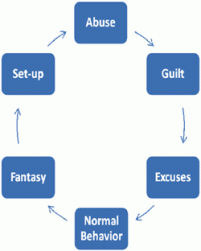
Power and control – Cycle of abuse


The system of bail is directly related to a defendant’s prior history of crimes, convictions, and lastly, the nature of the crime for which he is seeking bail.  The cycle of abuse is posted to the left. It is all about power and control of the victim. On average, police are called after 9 prior episodes of abuse. In general, they arrive when the couple is in crisis and he may be feeling guilt and making excuses for his behavior.  Or other times, the couple is in the honeymoon phase of the cycle and one partner invariably refuses to press charges on his partner.  This is what really infuriates police officers called upon to answer these potentially violent calls. “It was all a big misunderstanding” according to the dangerous partner.
I have posted several essays over the years on the topic of “dangerousness” in terms of it being considered prior to the granting of bail.  The June 2011 case in Maine culminated after the abuser was released from jail on $ 2000 dollars bail. After his death the money was returned to his family.  Some district attorneys have tried to withhold bail money when the defendant fails to appear in court due to death by suicide after domestic violence homicide (DVH).  For many this seemed like a draconian response to families who were in pain and suffering immeasurable.
“Many believe there is a disconnect between the judiciary and the bail system.” Sefton, 2011

What can be done to assure greater containment?

Containment refers to the need to protect a potential victim and his or her family from a violent often marginalized family member who is showing red flags of impending terminal rage.  A Domestic Violence review panel conducted in June 2011 concluded that “there is nothing society can do for a despondent, abusive spouse whose obsession overrides the norms of society – even his will to live”.  If we believe this then we will erroneously surrender innovation in domestic violence prevention and harm reduction.  When high-ranking prosecutors say domestic violence homicide cannot be prevented society is cheated out of taking steps toward containment of those who may violate protection from abuse orders.  Lois Reckitt, executive director of Family Crisis Services in Cape Elizabeth, ME is quoted as saying that the wrong people are in jail when violence-prone abusers are released from custody to stalk and terrorize their family, as was the case in the Dexter, Maine tragedy in 2010.  Containment and harm reduction should be the focus of the legal system and social service agencies alike.  The judiciary and political machinery in states throughout America must speak out about protecting victims and families and not say there is nothing that can be done to stop DVH.

Sefton, M. (2011). Domestic violence and domestic violence homicide. Blog post http://enddvh.blogspot.com/2011/10/domestic-violence-review-when.html Taken January 16, 2018

DVH in MA: 4-year old child begs father not to murder his mother


  • “… He stood in the doorway with a loaded gun and talked about killing himself and/or children and myself. He was bringing up old verbal threats and I thought they were going to come true”

    Amy Lake – from July 2010 order of protection

The words above were taken from a requested order of protection in the state of Maine in 2010.  The threats upon this victim and her family became a reality exactly one year to the day after this order was put in place in 2011. Amy

IMG_0771-1
Michael Sefton

Lake and her two children were murdered by her husband Steven Lake who killed himself as well. Immediately following the killings a Maine district attorney said “there was nothing we could have done to prevent these killings”. These were the words that triggered a team of professionals including myself to research the sequence of events that lead to this event.  A formal psychological autopsy was undertaken in 2011 following these murders and over 50 recommendations were generated (Allanach, et al 2011).

I am sick to my stomach as I write about another senseless killing of Wanda Rosa in Methuen, Massachusetts in late summer 2016.  The case resembles so many cases of domestic violence homicide – manipulation and control.  Ms. Rosa had a permanent order of protection but had recently modified the order to allow Emilio Delarosa to see the child they had in common. Why in the world would anyone allow Delarosa to see his son? He is no role model and the potential for terminal violence was readily apparent as depicted in the order of protection.  He expressed his intent to kill his girlfriend on more that one occasion.  Delarosa’s history of intimate partner violence had risen to the level of a permanent ban – signaling that the pattern of violence was undeniable and the red flag indicators for domestic violence homicide (DVH) were apparent in the eyes of the police and judiciary when the permanent order was granted.

Permanent orders of protection are rarely granted unless the pattern of violence was so prevalent and unremitting that the potential of harm or death to the victim and her family was unsurpassed as in this case.  It is known that Delarosa was manipulative and controlling of his girlfriend getting her to drop charges over and over and later alter the terms of the restraining order – ultimately resulting in her death.  Secondly, the person against whom the stay away  order is granted must have demonstrated a blatant indifference of the order of the court by having recklessly violated the order over and again. It should not have been altered.  In the past 18 months cases meeting these requirements (such as this one) have resulted in intimate partner violent deaths.  The Jarod Remy 2013 murder of Jennifer Martin is a despicable reminder of the need for change in cases of DV. Remy killed his girlfriend by stabbing her multiple times as the couple’s 4-year old child bear witness. In spite of laws designed to reduce the likelihood of DVH Rosa was not adequately protected.

Rosa’s boyfriend Emilio Delarosa is on the run as of September 20.  He is accused of murdering his former girlfriend after years of abuse, strangled her to death as their 4-year-old boy pleaded with him to spare her life, according to court records. “No Dad” the child was heard to say over and over. As in the Remy case, the 4-year old witnessed his father choking  Wanda Rosa until she was dead.

“I suspect there is a strong likelihood that he too will be among the deceased in the coming days as is the common eventuality among those who commit the unconscionable, violence that manifest in this terminal event” according to Michael Sefton, Ph.D., director of psychology and neuropsychology at Whittier Rehabilitation Hospital in Westborough, MA.  When some men violate the permanent protection order it is the result of unbridled rage and defiance against a “system” they believe has failed or unfairly humiliated them said Sefton in a release. They are murderous and often turn their rage inward in an act of suicide. I would look for the triggers of what set Delarosa’s terminal rage into action.  It could be something as simple as being told he needed to have monitored visitation with is son or learning that the female was seeing another man – both conjectural on my part.  After the alleged killing Delarosa was heard to say “It’s over, it’s over, it’s over” when speaking to his sister.

“This is the complexity of domestic violence and the cycle of abuse,” said Arelis Huertas, who oversees domestic violence and sexual assault programs at the YWCA of Greater Lawrence. “Many survivors say, ‘He’s a great father, he was only abusive toward me.’ 

“Domestic violence is not random and unpredictable. There are red flags that trigger an emotional undulation that bears energy like the movement of tectonic plates beneath the sea.” according to Sefton.  A psychological autopsy should be undertaken to effectively understand the homicide and in doing so contribute to the literature on domestic violence and DVH according to Michael Sefton who with colleagues published the Psychological Autopsy of a case from Dexter, Maine where a father murdered his child, estranged wife and ultimately himself (Allanach, et al, 2011).  In the days preceding the murder there are usually red flags or pre-incident indictors that people see that signal the intentions of the murderer.  These clues provide police and the judiciary with data to craft protection plans and are the commonalities found in cases of DVH across the state and across the world.  Some red flag behaviors signal the emergence of imminent terminal anger that can be seen in the social media accounts of intimate partners who go on to kill their spouses.  I am quite interested in the compelling reasons that Delarosa may have argued that resulted in the change in the permanent order of protection.  The outstanding Boston Globe article about the slaying is a sad reminder of the early warning signs of DVH.  All the red flags were present.  In a blog published in 2013 I list the tell tale warning signs of intimate partner homicide and the need for tougher bail conditions (Sefton, 2013).

The impact on the child will be lifelong. At age 4, children are developing their sense of gender identity in the setting of developmental growth, cognitive maturity, social functioning and continued individuation. Imagine the child who is reunited with his parent after a period of mandated protection due to DV.  He is now able to see his family and may be fraught with both excitation and fear.  It would be normal for the child to have fantasies of reunification of the family and perhaps self-blame for not having stopped the action of his father. Just like the daughter of Jennifer Martin and Jarod Remy this 4-year old boy will forever be reminded of the life he will not have.


Ronald Allanach et al., Psychological Autopsy of June 13, 2011, Dexter, Maine Domestic Violence Homicides and Suicide: Final Report 39 (Nov. 28, 2011), http://pinetreewatchdog.org/files/2011/12/Dexter-DVH-Psychological-Autopsy-Final-Report-112811-111.pdf.

Sefton, M. The red flags of intimate partner violence. Blog post taken October 2, 2016.

Sefton, M. Prior history of crime not predictive of DVH. Blog Taken October 2, 2016. post: http://enddvh.blogspot.com/2013/07/prior-criminal-history-used-to.

By the hand of a father’s son

Vermont patricide shows complex impact of veteran’s plight and DVH

WESTBOROUGH, MA  June 12, 2104  The Vermont killing of a veteran warrior this spring brought to light the high price being paid by military veteran’s who returned to civilian life unable to function.  Much has been published about the wait for treatment that many of the most needy veteran’s experience.  As Father’s Day approaches readers are urged to think about this case. It is particularly unsettling because the man’s death came at the hand of his son.  Kryn Miner, 44 was shot and killed by his son after threatening his wife and stating that he was going to kill his family.  Miner threatened his family with a gun a year before his death but the event was never reported to police. The shooting was called a justifiable homicide and no charges were filed against the teenage child who fired the fatal shots.  The child has not been identified out of privacy concerns and by all accounts may have saved the lives of his mother and 3 siblings.  The victim’s wife Amy has spoken out about the plight of veteran’s who are not getting the help they need. “The truth of the matter is if we can’t take care of our veteran’s we shouldn’t be sending them off to war” said Amy Miner.

The victim in this story was a 25 year Army veteran who returned from Afghanistan in 2010 after being deployed 11 times from 2007 to 2010. Miner was a career soldier and was well liked. He was shot 5 times in his Vermont home after threatening his family with a gun and throwing his son a loaded pistol saying “Do you want to play the gun game?” Mr. Miner had served tours of duty in Panama and Iraq as well.  He was suffering from the residual effects of a traumatic brain injury and experienced symptoms of post traumatic stress disorder. He was injured in combat after a blast threw him into a concrete wall. Ironically, after becoming dissatisfied with the V.A., Mr. Miner turned to the Lone Survivor’s Foundation for help and eventually becoming a spokesman for the foundation.  To his credit, Miner was committed to helping veteran’s suffering with emotional and physical symptoms from combat-related PTSD and was receiving treatment himself for this enduring injury.

The Department of Veteran’s Affairs is finding it difficult to manage the influx of veterans in need of care.  Ostensibly, the volume of cases exceeds the resources available at VA hospital and clinics throughout the country.  The Phoenix, AZ regional director has resigned because of the wait listing of patients and the obfuscation that occurred once the facts became known.

The story is one that compels the author to look at the complex interplay of domestic violence, guns, and the ongoing plight of war veteran’s.  The sheer number of men and women returning from the theater of war over the last decade is staggering.  It is estimated that 15 percent of these veteran’s are experiencing PTSD and/or the effects of traumatic brain injury from blast waves and other wounds. Arguably, this number may actually exceed 20-25 percent of all returning war veterans by some accounts.  The case of Mr. Miner is particularly troubling because it involved a history of domestic violence and criminal threatening that was never reported to authorities.  Had it been reported the Miner family may have been helped.

The immeasurable impact of this violence on the family may be reflected in the actions of one of its own – who must now live with the consequence of patricide.  The killing was justified according to the Vermont State Attorney General.  But how can one justify this when so young?  The killing of one’s father is often the manifestation of long felt anger, emotional pain, and in reaction to enduring humiliation.  The motivation in this case is not clear aside from the threat posed by Miner and the child’s immediate defense of a loved one – his mother and siblings.  Just how emotionally equipped this boy is to recover from this remains to be seen.  He will never forget what has happened to him and his family as long as he lives.  Each day this family must experience some loss and recurring trauma inextricably linked to the events of April, 2014.  Some responsibility lies with the victim who issued the threats and was armed with a gun.  He died by the hand of a father’s son that should never have been touched by such things.


Decisions on Bail for Domestic Violence

THERE IS MOVEMENT TOWARD VICTIM SAFETY IN CASES OF DV

lakefoll0916_kc01-250x250
Michael Sefton (right) BDN photo

WESTBOROUGH, MA   Is there any coincidence that Democratic House Speaker Robert DeLeo has joined forces with Attorney General Martha Coakley to bring forth a new bill that will provide for stiffer bail conditions and tougher sanctions for repeat DV offenders?  This bill was brought forth just 2 weeks after the Massachusetts SJC ruled on the case of one abuser against whom a permanent restraining order has been in place for over 10 years.  In that ruling, a man against whom a protective order was written is seeking its dismissal under the broad assumption that he is no longer  a threat to the former girlfriend because he now lives 3000 miles away.  Not so fast said the Massachusetts SJC.

The Commonwealth’s highest court reviewed the historic data in the case record and made its decision based on the documented threat of violence the abuser posed and convictions for DV against more than one partner dating back to the 1990’s.  They voted against dismissing the permanent restraining order writing that victim safety is more important than the purported rights of abusive men.  In the SJC decision the limitations placed on the abuser based on having a “protective order” against him were the collateral consequence of the behavior they exhibited early on.  The abuser believed he was unfairly being prevented from owning a firearm and had limited opportunity to work with children because of the unfair restrictions placed on him by the permanent order of protection.  Furthermore, the SJC also acknowledged that the abuser must show “convincing evidence” that they have made substantive emotional and personality changes that render him no longer a threat to the estranged spouse.

The bill proposed by Speaker Rober DeLeo asks for tougher bail conditions most notably a 6 hour delay before an alleged abuser may be released from custody.  The highly publicized case of Jared Remy who was released from custody hours before be allegedly killed his live-in girlfriend served as a stimulus to the proposed change in the law.  An important consideration not mentioned in the proposed bill is that to do with subjects with known violence in their history and how best to protect victims from revenge abuse once the abuser is released from custody.  Presumably, the new bill affords potential victims the opportunity to put in place a safety plan and affords those making decisions about bail added training about the cycle of abuse, red flag predictors, and greater access to the history of violence of the person in custody.

Unfortunately, the bill does not go far enough in its current raw form to assure that victims of violence receive the needed protection once they decide to break away from dangerous and dysfunctional entanglements.  It is this time when abuse victims are at greatest risk of death due to domestic violence as in the case of Amy Lake, a victim of domestic violence homicide whose case was carefully studied in the Psychological Autopsy of the Dexter, Maine Domestic Violence Homicide (Allanach, 2011) that occurred in June 2011.  Maine has been reviewing bail conditions since this unique study made over 50 recommendations for reducing the incidence of domestic violence homicide in that state.   This report was presented to the Governor’s Domestic Violence Homicide Review Panel in November 2011.  Only recently was a domestic violence suspect held without bail for his history of felony assault and battery on his spouse and a prior domestic partner for over 20 years.  In that case, the abuser was arrested three times in one month for violating an active order of protection during which time he threatened to kill his estranged wife.

Red Flags and Bail Conditions

In Massachusetts, Speaker Robert DeLeo warns that red flags often foreshadow an abuser’s behavior giving clues as to the intentions and the proclivity toward violence.  These are facts that are well described in the literature on DVH.  It is suspected that perpetrators ostensibly inform others about their intentions and all to often, these individuals do nothing to stop the violence.   In a prior paper, I have argued that a domestic violence registry may be useful for keeping track of those who repeatedly abuse or batter their domestic partners.  This would be similar to the sex abuse registry that requires those adjudicated for sexual abuse of children must register whenever they move from place to place.  I have also written extensively on the need for containment of those at highest risk to offend including a pertinent history of physical violence e.g. choking coupled with threats of death, access to firearms, prior violation of an order of protection, the presence of more than one simultaneous protection order (multiple victims), and other forms of coercive control such as destroying personal mementos like favored Christmas ornaments and personal photographs.   A pattern of substance abuse further elevates the risk for domestic violence and DVH.

There are changes taking place in the way in which domestic violence is handled in many states here in the U.S.  Bail conditions are being reviewed with more stringent constraints being placed upon abusers including no bail containment of the most egregious and violent cases.  Further options like GPS monitoring and a domestic abuse registry are being considered in some jurisdictions.  Some experts are calling for added training for judges and greater access to DV history before making decisions about bail conditions.  Arguably, these examples will all add to greater victims security but do very little when emergency protection orders are issued by judges during the night.  Police are frequently asked to present information to an on-call judge in an effort to provide immediate protection following a suspected incident of DV.  This information is critical in conveying what risk exists to the victim or potential victims.  Many police agencies are using dangerous assessment tools to compile and enumerate the red flags that may be the harbinger of terminal rage and the end of one’s timeline somewhere.

Ronald Allanach et al., Psychological Autopsy of June 13, 2011, Dexter, Maine Domestic Violence Homicides and Suicide: Final Report 39 (Nov. 28, 2011), http://pinetreewatchdog.org/files/2011/12/Dexter-DVH-Psychological-Autopsy-Final-Report-112811-111.pdf.

Maine man held without bail in case of DV

Judicial_Review_02WESTBOROUGH, MA March 30, 2014  The Portland Press Herald reported on the case of Jason Lawrence who is being held without bail for domestic violence.  He is a repeat offender whose violence against women can be traced back to 1997.  Is anyone surprised that the well-being of victims in this case were not considered by the judicial system who twice released Mr. Lawrence into the community. Finally, the perpetrator’s actions convinced someone he was the real deal and is being held without bail in Maine. At what point does the well-being of victims and potential victims rise above the abuser’s right to bail?  Some circumstances warrant the containment of those who exhibit abject cruelty over and over.  Many states including Massachusetts are beginning to realize how emotionally dehiscent an abuser can become.  The case in Maine is the first I have seen to hold a violent abuser without bail in that state.

Recently, the SJC in Massachusetts denied to remove a protective order that has been in  place over 10 years.  He claimed to have “moved on” and wanted to work with children and own firearms – arguably two rights surrendered when domestic violence allegations have been proven against you.  The SJC called the rights of abusers to have protective orders dropped years later – as the collateral consequence for the years of documented abuse (Sefton, 2014).

In the June 2011, Dexter, Maine homicide, one police officer was heard to say he had never before been so afraid for a victim of domestic violence and in spite of those fears and having access to firearms, Steven Lake was released from custody with little bail. The subsequent Psychological Autopsy conducted in 2011 by 4 current or former law enforcement officers identified red flags – just like those exhibited by Jason Lawrence – as being highly predictive of domestic violence homicide (Allanach et al., 2011). Mr. Lake killed his family and then himself in June 2011. People knew this was his ultimate intention and said nothing until the terminal rage he concocted resulted in the deaths of 3 innocent citizens from the state of Maine. Red flags were identified in the post hoc analysis of the case and were presented to the Domestic Violence Homicide Review Panel in November, 2011 in Augusta.

Does anyone doubt what Mr. Lawrence’s ultimate intention was in the 3 weeks between arrests? His anger and marginal behavior were escalating by the day. It did not matter to Lawrence that a protective order was in place.  A “no contact” order means nothing to a man who believes all control has been taken from him.  Arguably, when a district attorney identifies someone as “one of the worst domestic violence individuals ever” – as in this case, those words should be key is setting the parameters for bail. Greater discretion for bail is necessary in this case just as when a police officer believes a victim is not safe from her purported abuser. Ultimately, the premonition of the deputy sheriff in northern Maine came true on the morning of June 12, 2011.

Mr. Lawrence is not afraid of the police or being sent to jail because he has no limits on what he can do. He does as he pleases and containment is the only correct solution.  Red flags were apparent as far back as 1997.  The valid predictor of future violence is past violence. regrettably, the secrecy of victims and those who choose remain silent are the one’s who might stop domestic violence.  And as a society we must do something to bring a voice to these individuals because to do nothing is unthinkable.

Read more from the Bangor Daily News:

http://bangordailynews.com/2011/11/28/news/piscataquis/report-details-dexter-family-murder-suicide-calls-for-new-way-of-handling-of-domestic-violence-cases/

Citation:

Ronald Allanach et al., Psychological Autopsy of June 13, 2011, Dexter, Maine Domestic Violence Homicides and Suicide: Final Report 39 (Nov. 28, 2011), http://pinetreewatchdog.org/files/2011/12/Dexter-DVH-Psychological-Autopsy-Final-Report-112811-111.pdf.

Sefton, M.S., Collateral Consequences, taken on 3-30-14,  https://msefton.wordpress.com/2014/03/11/collateral-consequences-stay-away-orders-that-are-forever/

Domestic Violence Homicide: What role does exposure to trauma play in terminal rage?

IMG_2126
Sgt. Michael Sefton in NBPD Humvee used for patrol and search/rescue

First responders experience trauma as job-related way of life


WESTBOROUGH,  MA December 1, 2013 There is a new question in my mind about the exposure to trauma, e.g. war-related PTSD and the possibility that it plays a role in domestic violence and domestic violence homicide later on.  While this link may be plausible, there are no scientific truth to the notion that DVH is caused by one’s exposure to war or on-the-job exposure to horrific events.  Scott D. Jones of Arlington, MA was a decorated paramedic who responded to a mass homicide in 2000 in which 7 people were shot in an episode of workplace violence. He would go on to kill his second wife and family 14 years later after repeated episodes of severe depression and suicidal behavior and domestic violence toward his first wife.  These behaviors were the first red flags of an impending emotional breakdown and terminal rage.

Returning veterans and those in the police and EMS service witness suffering and anguish that are outside of the normal human experience rendering them vulnerable to recurring trauma and a host of physical and emotional ills. Some believe the prevalence of PTSD among EMS first responders (including EMT paramedics) is as high as 16 percent (DeAngelis, 1995, p.36).  Most services require critical incident debriefing after incidents that are particularly catastrophic – especially those resulting in death of a member of service or the death of a child.  These sessions have been shown to reduce the incidence of post-incident symptoms by offering support and context for individual responders as to their individual role in the event. It is not psychotherapy although emotions are often evoked as remembered details emerge and become palpable.

What is the link between unresolved trauma and DV? It is well-known that a high incidence of substance abuse exists among first responders.   “The emotional wellness of emergency service workers is at risk. Stress and grief are problems that are not easily detected or easily resolved. Severe depression, heart attacks, and the high rates of divorce, addiction, and suicide in the fire and EMS services proves this” according to Peggy Rainone who offers seminars in grief and surviving in EMS. To what extent this behavior evolves from on-the-job experience is subject to debate but chronically high levels of stress contribute markedly to marital discord, job conflict, and a host of physical anomalies like hypertension.

kids_imagesThe link between chronic stress and behavioral health is well-known.  Does this link extend to higher risk for domestic or intimate partner homicide?  The recent case of domestic violence homicide in Arlington, Massachusetts raises the specter of DVH in first responders. In this case, a decorated paramedic allegedly killed his children, his wife and then himself.  The abuser had a history of physical and emotional abuse as reported by a first wife.  There was a history of alcohol abuse.  The abuser was involved in a whistle-blower case against his employer that was slowly making its way through the courts.  But outwardly, he and his family seemed happy. What might trigger such an emotional and deadly maelstrom?  What triggered the terminal rage that released this decorated man – creating a monster?

In some cases, post incident analysis of the psychological forces acting on the abuser is necessary and will provide insight into the chain of events that pulled on the trigger. There is no single answer but a host of identifiable “red flags” likely contributed to the loss of control associated with DVH.  A thorough psychological autopsy may uncover factors leading to unresolved anger and the many unknown variables driving violent behavior. I have previously published blogs on the psychological autopsy and its utility.  The benefit of a thorough PA has value for all of mankind.


  1. DeAngelis, (1995, February). Firefighters’ PTSD at dangerous levels. Monitor, pp. 36-37.
  2. Rainone, P. (2013) Emergency workers at risk. Taken 12-1-2013 (website) http://www.emsvilliage.com/articles/article.cfm?ID=176.

The Day She Said Goodbye

 The day she said Goodbye

Michael Sefton

Who knew that the day she said goodbye would be the day that set a clock to start ticking.  Her parents thought they were an ill-matched pair from the start but they did not want to interfere.  Even her best friend said he should cut him loose.  Who knew that by saying goodbye that her risk of domestic violence homicide was increased by a factor of five?

But wait, isn’t it important for victims of domestic violence to break away from the coercive grasp of their tormenting intimate partners?  A sign of empowerment, they say.  She wanted to move on, finally having the courage to say goodbye after he held them all at gunpoint.  Ranting that if she ever tried to leave him he would kill her.  His hubristic thinking was never as obvious as on the day she said to goodbye.

The next day, he knew something was up when the sheriff’s deputy pulled in behind his truck and activated the pulsating blue lights.  “Your mother has really done it this time” he said to his 12-year old son.  He also had a clock ticking, unbeknownst to him or anyone else.  The boy’s mother never wanted this to happen and never expected it would become so dangerous to she and her 2 children just when she decided it was time to say goodbye.  The deputy who took him into custody that day was in fear for the child’s mother, he would admit at some point.

Victims of domestic violence are at greatest risk when they decide it is time to end the cycle of power and control. Those who work with victim’s advocates are thought to experience less abuse and report a better quality of life. This takes time, and time is all they have in the world to break the chain of violence.

People thought he was just a neighborhood bully.  They later learned he was intimidating, sadistic and sexually aggressive.  He hated his daughter when she was born and he wished she were a boy.  When she started to walk he would trip her and laugh.  It was a joke to him he would later say.  No one knew but there was a clock ticking for the little girl as well.  These were the first red flags.  Together these three shared a secret, with him.

After being criminally threatened, she was issued an order of protection.  It meant that he could have no contact with his wife or the children.  It also required that he attend counseling sessions.  In spite of this, the extent of his anger was never fully appreciated according to a state official.  Meanwhile, she also filed for divorce and he began to fester.  His jealousy and suspicion grew.  He too had a ticking clock only his was more of a ticking bomb.  Just because she had the nerve to say goodbye.

That year was a dream come true.  She met new people and managed the transition to a single parent household better than most.  She taught kindergarten and was everybody’s mother.  That year she began to feel happy – people noticed.  Her children too started to move on.  On social media websites she would post her pride in her kids with photographs and video.  She had a plan that would keep them all safe from him.  Soon it would be time to say goodbye to the controlling, manipulative abuser.

Not so fast.  He was not satisfied with this arrangement.  His wife could no longer put up with his charade.  In the months after he was ordered to stay away from his family the impact of his estrangement began to whittle away the exterior of bravado.  Arguably, he did what he pleased like standing in line behind her at a local coffee shop in violation of the court order.  He launched a social media diatribe lauding his achievements as a father and husband.  He lied about all that he had done and minimized having held a firearm on his wife and children.  Suddenly it was her fault that he could not see the children.  She was harming the kids by keeping them from their beloved father, he espoused.  Poor soul.  The irony in his internet blitz was lost on a bevy of friends who “liked” his daily status reports. They insisted he fight for his children. Time was ticking toward the 8th grade commencement exercise he wanted to attend, ostensibly to portray himself as someone everyone knew he could not become.  Time too was growing near to the final divorce decree and to his day in court.

By now people began hearing the ticking clock.  Family members said a change came over him.  He was depressed and talked of suicide.  “When I do it, it will be on CNN” he managed with his typical hubris.  He faced the end of his 10-year marriage and a court trial from his action one year previously.

All at once, the totality of his anger and deception came into focus to the police who saw his truck in her driveway.  They were called when she failed to come to school on that day.

Some saw how much danger they were in and did nothing.  Red flags raise the specter of risk.  “I never thought he would take the kids” said a family member, in a matter of fact way.  Others blamed a district attorney for not lightening up on the stay away order saying if the D.A. had only allowed him to attend the commencement exercise he would not have done what he did.

No one knows what the impending loss of time meant to him, time in jail? Time alone?  What happened next is well documented.  He set his alarm clock for 4:45 and wrote letters to his family — 10 in all.  “I’ll see you in hell” he scribed to his wife. He entered the rental home while they slept, his intentions known only to him.  For 2 hours he raged on setting the scene.  Finally time stood still for all four.  The family’s timeline came to an end – all at once – all because she had the courage to walk away, to make a better choice for her children, and to say goodbye once and for all.

Michael Sefton, Ph.D.

Dr. Sefton is a police sergeant in New Braintree.  Along with three colleagues, Ron Allanach, Brian Gagan, and Joe Laughlin researched the Psychological Autopsy of the June 11, 2010 Dexter, Maine Murder/Suicide and made over 50 recommendations for reducing harm to people living with intimate terrorism.  They presented their findings before the Domestic Violence Homicide Review Board on November 11, 2011 in Augusta, ME.

Read more:

http://www.enddvh.blogspot.com