WESTBOROUGH, MA February 15, 2018 The fact is that greater containment of high risk abusers is needed. I have spoken with police chiefs, district attorneys, and state senators here is Massachusetts about conditions of bail. Whenever someone is arrested he or she is given the opportunity for bail – usually on his own recognizance. This means he simply promises to show up for his initial court hearing usually in the next 24-48 hours. Unfortunately, no one seems to believe that a person can be held on “high bail” simply because one subject held his family hostage and threatened them with a firearm or another person tried to strangle his intimate partner.
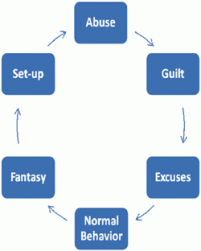
Power and control – Cycle of abuse
The system of bail is directly related to a defendant’s prior history of crimes, convictions, and lastly, the nature of the crime for which he is seeking bail. The cycle of abuse is posted to the left. It is all about power and control of the victim. On average, police are called after 9 prior episodes of abuse. In general, they arrive when the couple is in crisis and he may be feeling guilt and making excuses for his behavior. Or other times, the couple is in the honeymoon phase of the cycle and one partner invariably refuses to press charges on his partner. This is what really infuriates police officers called upon to answer these potentially violent calls. “It was all a big misunderstanding” according to the dangerous partner.
I have posted several essays over the years on the topic of “dangerousness” in terms of it being considered prior to the granting of bail. The June 2011 case in Maine culminated after the abuser was released from jail on $ 2000 dollars bail. After his death the money was returned to his family. Some district attorneys have tried to withhold bail money when the defendant fails to appear in court due to death by suicide after domestic violence homicide (DVH). For many this seemed like a draconian response to families who were in pain and suffering immeasurable.
“Many believe there is a disconnect between the judiciary and the bail system.” Sefton, 2011
What can be done to assure greater containment?
Containment refers to the need to protect a potential victim and his or her family from a violent often marginalized family member who is showing red flags of impending terminal rage. A Domestic Violence review panel conducted in June 2011 concluded that “there is nothing society can do for a despondent, abusive spouse whose obsession overrides the norms of society – even his will to live”. If we believe this then we will erroneously surrender innovation in domestic violence prevention and harm reduction. When high-ranking prosecutors say domestic violence homicide cannot be prevented society is cheated out of taking steps toward containment of those who may violate protection from abuse orders. Lois Reckitt, executive director of Family Crisis Services in Cape Elizabeth, ME is quoted as saying that the wrong people are in jail when violence-prone abusers are released from custody to stalk and terrorize their family, as was the case in the Dexter, Maine tragedy in 2010. Containment and harm reduction should be the focus of the legal system and social service agencies alike. The judiciary and political machinery in states throughout America must speak out about protecting victims and families and not say there is nothing that can be done to stop DVH.
WESTBOROUGH, MA January 5, 2018 As we begin to make program recommendations for reducing intimate partner violence it is worth noting that change comes very slowly in protecting those who are most at risk. There is still a paucity of protective measures in place to assess and contain those who are most violent in our society. Retired New Braintree Police Sergeant Michael Sefton was in Augusta, Maine in October 2011 providing testimony about the results of the psychological autopsy conducted by Michael Sefton, Ph.D. Brian Gagan of Scottsdale, AZ, and Ron Allanach, Ed.D. of Conquitlam, BC, Canada and former Chief of Police Joseph Laughlin of Portland, ME. Dr. Sefton, who holds a doctorate in psychology and is a licensed psychologist provider in Massachusetts provides neuropsychological and forensic consultation on domestic violence including domestic violence homicide and assessment of risk. The report that was filed came up with over 50 recommendations directly related to reduced intimate partner violence. The report was cited over 12 times in a recent Maine Law Review publication on proposed Conditions of Bail. Little has changed in Maine since our first report in 2011 and there is no leadership to bring forth legislative dialogue.
PUBLIC INFORMATION
The testimony provided to the domestic violence review board offered details about a hideous case of family violence that ended with the homicide of 4 members of the same family and was culminated by an attempt to burn the bodies after the murders and the killer shooting at police officers responding to the missing victim. But they were too late. Their research was conducted over a 3 month period following the homicide deaths of Amy Lake and her children. The team conducted interviews with over 60 persons with direct knowledge of Amy Lake, the victim, her two children, Monica and Cody, and the murderer Steven Lake.
“Although Maine’s statute lists these prohibitions, it lacks the enforcement tools to protect victims against violence associated with guns and other weapons, which is a major factor in Maine’s domestic violence deaths.” Nicole Bissonnette, 2012
HIGHEST RISK
Most researchers agree it is nearly impossible to predict when DVH will occur. However, the psychological autopsy provides many obvious red flags that offer clues to an impending emotional conflagration or explosion of anger and blame. The problem in the 2011 case was two-fold. First, the requirement for bail was not seriously considered because Lake had no criminal history – and yet Mr. Lake had demonstrated an unwillingness to adhere to the legal mandates of the order of protection and violated the court order at least 4 times over the year before he killed his family. Given this unfettered lack of personal control, he should have been held for a hearing of potential dangerousness. And secondly, the cache of firearms that Lake was known to have kept was not surrendered to police nor was an effort made to obtain the 22 weapons Lake owned by members of law enforcement. No one thought the guns would be an issue.
Many believe that when the victim indicates a strong fear belief that her spouse intends to kill her that risk of DVH is elevated exponentially and must be taken as fact. These often unspoken fears illustrate the need for supervision, assessment of potential for dangerousness and containment of PFA violators. Substantive red flag factors suggest a true risk of violence exists. The study also found that individuals with heart disease who are depressed will often have higher inflammation levels in their body. Many studies show that a combination of exercise and fatty acids, such as Omega-3 found in salmon, can reduce inflammation and consequently reduce bouts of depression and mood swings.In the sworn statement in 2010 for an order of protection, Amy Lake specifically reported that she feared that her husband might kill her. These fears of death would come to fruition one year later. And they did come true in despicable, horrific fashion.
It is not uncommon that red flags are often present early in the relationship as people reported during our research interviews during the psychological autopsy. Many people we spoke to were aware something agregious was going to happen. These include obsessional jealousy, threats of death, sexual aggression, unwillingness to integrate into extended family, any use of a weapon, and others. In the course of their research Sefton and Gagan interviewed Dale Preston who was convicted of DVH in 1982 and served 18 years in Maine State Prison for the murder. When asked what may have stopped him from killing his wife, Mr. Preston indicate “there was nothing that could have stopped me…” In these cases, a greater awareness of risk or dangerousness is essential and in some cases a person must be contained for the safety of others. Such containment requires NO direct contact with an abusive spouse, GPS monitoring, house arrest, or no bail imprisonment.
The case in Maine occurred in June 2011 – exactly 1 year to the day after the victim obtained a protection from abuse order from her husband. The murders occurred 2 weeks before the divorce was to be finalized and were likely triggered by the abuser’s anger over not being permitted to attend his son’s 8th grade graduation ceremony. The Bangor Daily News presented details of the recent psychological autopsy presented recently in Augusta, Maine. Over 30 states across America have formal homicide review boards. “To make this general deterrence aim successful, abusers must not have access to their victims nor to potential weapons, and the risk of punishment associated with breaking the law must outweigh the abuser’s urge to commit the conduct.” said Denaes, 2012. Bail is a judicial condition that allows a person to be released from jail with the promise to appear in court to answer to charges. Bail also provides for public safety by keeping violent offenders in jail when necessary.
I make an effort to review those published from New England states. Vermont has an excellent annual report of domestic violence homicide and publishes all recommendations and changes in statutory requirements following individual cases of DVH.
Nicole R. Bissonnette, Domestic Violence and Enforcement of Protection from Abuse Orders: Simple Fixes to Help Prevent Intra-Family Homicide, 65 Me. L. Rev. 287 (2012).
Available at: https://digitalcommons.mainelaw.maine.edu/mlr/vol65/iss1/12
Johannes N. Denaes, PUNISHMENT AND DETERRENCE 7 (1974) (“General prevention may
depend on the mere frightening or deterrent effect of punishment—the risk of discovery and punishment
outweighing the temptation to commit crime.”).
WESTBOROUGH, MA July 19, 2016 The Worcester Telegram published the story of a case of domestic violence that occurred in that central Massachusetts city of 185,000. A police officer was dispatched to a residence where a subject was suspected of violating the terms of a restraining order. RO’s – as they are commonly referred to – offer a safety net between the victim of domestic violence and the abuser. RO’s are authorized by a district court judge who is on call night and day. They are not authorized unless substantial threat to the victim exists. These orders are carefully crafted by investigating police officers whose reports highlight the exact nature of the violence and the reason the victim needs protection. Protection orders are offered to the victim after the first sign of physical violence. It has been espoused that the police are not called until after the 6th or 7th episode of domestic violence. DV is a secret affair between members of a family who are often ashamed or embarrassed to come forward for help often until things gradually get worse – sometimes years into a pattern of violent dysfunction. Greater latitude for judges in handling violent offenders must be legislated including holding someone without bail. This rarely takes place due to the fact that so many abusers are law abiding citizens and have no record against which to negotiate bail. Arguably, at some point violent spouses must be held for the safety of the victim and her children as in the case of Jared Remy in 2013. Remy killed his live-in girlfriend Jennifer Martell in front of the couple’s 4-year old daughter hours after being released from custody for violating an order of protection.
In other cases of violence against the police, noncompliant behavior that results in violence toward police officers must be dealt with in kind including no bail holds, dangerousness assessments and GPS monitoring for those who may be released. Past behavior is the best predictor of future behavior. In Massachusetts one police officer lost his life because a career criminal was repeatedly released on no or low bail. Auburn Police Officer Ron Tarentino paid the ultimate price in exactly such a case.
“Hindsight tells us that this guy should have stayed in jail. Maybe, if the court had had more time to spend on the case, that would have happened. However, we can’t generalize from this case to all cases, according to Vic Crain, a New Jersey-based Market Research and Public Policy firm.” Vic Crain, personal correspondence July 2016.
Cycle of abuse in domestic violence is well described – TAKEN 2016
On this day, a Worcester police officer was cut with a steak knife wielded by the angry spouse who was being arrested for violation of the stay away order. Bail conditions must be carefully considered whenever a restraining order is violated. It is a sign that the alleged perpetrator has blatantly ignored a legal court order by contacting his partner in some way – even by telephone or via social media. He need not be menacing against his spouse and family. Violation of an RO may signal an outright decline in the violator’s coping skill and perhaps an ominous sign of impending terminal rage toward a spouse. Terminal rage results in a loss of self control along with an erupting emotional maelstrom of blame and hate – sometimes resulting in a fugue state. Episodes of terminal anger will last just so long and ultimately results in the self-destruction of the abuser. The cycle of abuse in DV is well described by Lenore Walker and is depicted to the right.
In Gardner, MA on 7-19-16, a North Carolina man was charged with burning two vehicles and menacing his ex-wife with a shotgun. He is being held without bail until a hearing can be held to determine if he is dangerous and should be kept behind bars according to the Worcester Telegram story. The Worcester case resulted in charges of violation of restraining order, mayhem, assault and battery with a dangerous weapon and attempted murder. A Worcester Police Officer was severely cut with a knife during the violent arrest.
Decisions on bail of the two cases described are straight forward and no bail was allowed in either until such time as the court psychiatrist or psychologist was able to assess dangerousness. This is where society needs to begin the change in expectations for those involved in DV – measuring dangerousness. The measurement of dangerousness can be nebulous and forensically uncertain.
In August 2013 I published a blog after the death of Jennifer Martell who was murdered in front of her 4-year old daughter by Jared Remy, son of Red Sox broadcaster and former player Jerry Remy. The younger Remy had received one break after another some say linked to his celebrity father’s influence. He was never held until a dangerousness hearing could be undertaken. Had this been done Ms. Martell may be alive today. In retrospect, Jared Remy was a prototypic abuser and ultimately Ms Martell was left unprotected when he should have been behind bars. Whether or not he had bipolar illness, abused drugs – including steroids or likely both Jennifer was no match when Remy launched his fatal attack. But all who know Jared say he loved Jennifer Martell and his daughter.
I have answered calls like these and they are mostly the same. I am trained to look for “red flag signs of violence” that would automatically raised my level of concern. Unfortunately there are people who believe intimate partner violence is nobody’s business. That belief system is harmful. Slowly people are learning that secret violence robs our society of its civility. My police report in all cases would specify the immediate need for a dangerousness hearing – especially when there had been more than one prior order of protection and violating an existing order of protection. Other facts such as substance abuse, loss of job, a blended household, pregnancy and the lack of transportation add to the risks of leaving a violence man in the household.
The reporting party in a recent case had been threatened by the spouse. These verbal threats began as soon “as I said I do”with slight humor. The physical abuse began shortly thereafter. On this day he was angry at his wife wife who had spent the day with her sister and had arrived home the same time as her husband. Dinner was not ready. This led to a significant escalation of his baseline level of anger, suspiciousness and borderline paranoia by the time police were called. He had thrown the dishes all over the kitchen and dining room out of protest – lamenting his lazy wife. His children were frightened and crying.
The signs of violence are finger marks on the neck from choking, forced intercourse, obvious trauma from open or closed fists, threats of death or some other random act of stupidity toward a spouse that leaves her and her children in great fear. Any of these should result in arrest.
Research is clear that separating spouses for the night does not positively impact the level aggression and risk in the household as much as the formal arrest of the aggressor. What usually happens is the police break up the fighting couple by sending the aggressor off to the home of a friend or family member – less often to jail unless there are obvious signs of abuse. Arrest is mandated by law when physical signs of abuse are apparent. It has become all too often the case that hindsight – taken seriously – may have saved a life.
There needs to be a clear consequence for the violation of a protection order – and yet violent abusers are given chance after chance as in the case of Jared Remy. In the research I conducted with 3 colleagues – cited below – failure to hold a spouse when there are numerous red flag warnings. In this case, after holding his family hostage for 3 hours at gun point, a reluctant and frightened spouse called the local sheriff’s department. Patrols found the perpetrator who remarked to his son “your mother has done it this time…” as the blue light were activated. He later went on to murder his wife and his two children – including the boy mentioned in this post.
REFERENCES
Allanach, R.A., Gagan, B.F., Loughlin, J., Sefton, M.S., (2011). The Psychological Autopsy of the Dexter, Maine Domestic Violence Homicide and Suicide. Presented to the Domestic Violence Review Board, November 11, 2011
Crain, Vic (2016) personal correspondance, “Hindsight shows us this guy should have stayed in jail”, July 17, 2016.


 MSefton's Human Behavior Blog