Covid-19 pandemic: No more important time for resilience

It has been frequently mentioned that exposure to death and uncivilized brutality has an impact on wellness and personal resilience. Not a surprise. Especially in these pages, I make an effort to point out that the cumulative impact of traumatic exposure slowly whittles away one’s capacity for mental health, empathy and emotional efficacy. “There is a relationship between the severity, frequency and range of adverse experiences, and the subsequent impact on mental health.” (Dillon, Johnstone, & Longden, 2012). The conundrum has always come down to just what constitutes a “traumatic” event in childhood? Sometimes there is no single identifiable event that a child brings forth that may later become a trigger of serious emotional instability later in adulthood.

The Covid-19 virus has the potential for creating traumatic events depending upon the degree of exposure and a child’s understanding of the narrative brought forth by parents and other trusted adults during the pandemic. “Over 30 percent of Americans know someone who has died or been infected by the virus. The fallout to mental health from the coronavirus is real. I see it in my own family as nerves become frayed 8 weeks on.” according to the blog post from May, 2020. Trauma informed therapy supports the model of early traumatic experience being the underpinning of many mental health outcomes we see later in life. The biopsychosocoial model identifies physical abuse, sexual abuse, exposure to violence, chronic substance abuse as the substantive reasons for many mental and physical illnesses years later. When we look in the rear view mirror at this virus we will see the litter of emotional wreckage that may leave its hooks in many people around the globe.

Coronavirus. Ise.ac.uk

There is a relationship between the severity, frequency and range of adverse experiences, and the subsequent impact on mental health.

(Dillon, Johnstone, & Longden, 2012).

“The more adverse events a person is exposed to in childhood, the greater the impact on physical and mental health and well-being, with poor outcomes including early death” (Anda, Butchart, Felitti, & Brown, 2010; Anda et al., 2006; Felitti et al., 1998). There was a time in my training that I collected data on childhood fire setting and the psychodynamics of pyromania. I saw 50 children in my fellowship year who came because of fire setting. Without a doubt, there was marked early instability in the childhood homes in these kids that likely germinated into fascination with fire play and perhaps more directly, physically aggressive behavior. Many of the children I assessed were suffering from early onset trauma.

Depending upon the age of onset using fire as an expression of internalized conflict suggests a serious emotional disorder in need of expert assessment and treatment. The interest in fire may appear normal but slowly interest foments in homes where a prevailing emotional vacuum permits – decreased emotional warmth, access to fire starting materials, an absent parent, and frequent domestic violence.  

The inconsistent and unpredictable exposure to violence contributes to excessive and unpredictable behavior as children become adults. Often without direct knowledge of a specific trigger, trauma activates brain circuits that drive fear and emotional behavior including substance abuse, domestic violence, and assault. What is more, these absorb community resources as psychological needs grow.

The coronavirus has profound impact on the emotional stability of people around the world because of its unpredictability and lethality. It evokes fear, and uncertainty as it spreads unchecked. Later, the virus can serve to trigger long hidden memories in a way that can sabotage healthy human development leading to vague anxiety, physical symptoms, loss, and deep despair.

Scott D. Jones of Arlington, MA was a decorated paramedic who responded to a mass homicide in 2000 in which 7 people were shot in an episode of workplace violence. He would go on to kill his second wife and 2 children 14 years after repeated episodes of severe depression and suicidal behavior and domestic violence toward his first wife.  These behaviors were the first red flags of an impending emotional breakdown and terminal rage. Paramedic Jones certainly had problems but the repeated exposure to trauma – especially the mass shooting, activated his fight-flight response intolerably and may have been one of the demons he faced in the end.

Michael Sefton, Ph.D.

Trauma can be triggered by loss due to Coronavirus in two ways. First, by direct contact with a family member who is hospitalized and may have died. Nearly every person who contracted the virus had someone left behind that was worried about their health and eventual recovery. Many had family members who communicated with patient via text messaging and FaceTime – until the loved one could no longer do so. Families relied on the updating calls of first responder nurses, chaplains, social workers, and physicians.

Next, through secondary exposure to similar cases and media coverage that assails efforts at closure and engrains the narrative of fear, guilt and shame by reporting ever increasing case numbers, hospitalizations and deaths survivors are left feeling numb and unable to mourn. Funerals were deferred or could not be held at all as some jurisdictions required the cremation of the remains of coronavirus victims. This has a negative impact on survivor health and well-being often evoking a religious and moral crisis of faith. Survivors have enormous guilt and sadness not being with a loved one who died from the virus or waiting to go for medical at the onset of symptoms. They mourn to mourn and are left feeling numb at the lack of closure.

So whether it is early trauma associated with domestic violence or trauma from repeated exposure to work-related experiences, there is a resilience that resides within most people that guides the rise from being overwhelmed again and again to move forward with courage and hope and feelings of hardiness. These are learned responses to high stress events like a pandemic, but people who are positive thinkers, optimistic, physically fit and emotionally insightful rise up, controlling the lives they lead.

We are offering a zoom platform event entitled The Psychological Impact of the Cornavirus Pandemic: Common sense answers on November 11, 2020 at 5:30 EDT and again in December 10, 2020 at 7 PM. It is free and to be sent the zoom link contact: jswiderski@whittierhealth.com or call the Whittier Rehabiltation Hospital at 508-870-2222 in the U.S. If you plan on attending the 12/10/2020 session please drop me an email at: msefton@whittierhealth.com

Michael Sefton, Ph.D.

Risky business: Faucci will not vote against the virus

The Corona virus has taken over 120,000 American lives since it began its tornadic viral defoliation of senior citizens and others with preexisting conditions in the Spring of 2020. The virus caught Americans unprepared. Everything has changed. The impact of the virus has been like a tsunami wave around the world whose point of origin is the giant industrial city of Wuhan, China. Only now are countries like Brazil being decimated and will soon top the United States in total cases and deaths. Countries who went into immediate lockdown were less effected like Norway, New Zealand, and Canada. The United States waited too long and the virus took hold. 

States here in North America, like Georgia, Arizona, and California, who grew weary of the economic impact of the virus and put forth ambitious reopening plans are now seeing record numbers of cases for the first time. The rate of infection is now being felt among younger citizens without pre-existing infirmity. 

Concerns about negative secondary outcomes of COVID-19 prevention efforts should not be taken to imply that these public health actions should not be taken,” wrote the CDC in one of its briefing statements. Secondary outcomes include the broad range of emotional responses to the virus including depression from loss of loved ones, sudden unemployment, increasing substance abuse, threat of homelessness, anger and existential anxiety from loss of control and loss of purpose in life. “However, implementation of supports should include a comprehensive approach that considers multiple U.S. public health priorities, including suicide prevention.” 

The Psychological toll of pandemic is beginning to show after festering for 3 months. The loss of employment, fear of foreclosure, food shortages, price gouging, addiction, and family conflict each increase the bonifide stress associated with the disease and its impact on the human family. People are becoming rattled. The President understands this and wants to exploit the opportunity by holding a campaign event. Trump brushed off concerns about the virus ahead of his highly anticipated rally in Tulsa, Oklahoma, because the number of cases there “is very miniscule”, despite the state’s surging infection of according to a report in the Boston Globe.  Instead, the rally was miniscule and embarrassed the President. 

Top physician and epidemiologist, Anthony Faucci has stated that given the unprecedented and unpredictable nature of Covid-19 that lessening of current social distancing protocols, the use of masks in public, and contact tracing are the best hope for keeping the number of new infections trending downward and to lessen the number of people who die from Covid-19. States who reopen for business without these same precautions are at risk for spikes in cases and more death. Since mid May we have heard from Dr. Faucci less and less as the White House has tried to imply that these concerns are unwarranted and there is “very little of the virus left”. 

President Trump, himself something of a germophobe, has put the needs of the campaign before public health and safety for the sake of his raucous and fervent base. In doing so, he will create a campaign spike that will be measured by new cases and deaths in the next 3-6 weeks time. That is on him and the courts who failed to put limits on the event or cancel it all together in Tulsa, Oklahoma on Saturday June 20. Since February, the president has not taken the pandemic with the kind of leadership that demonstrates his understanding of the virus and respect for those who have succumbed to the disease. 

Meanwhile states like Georgia, Texas, California, and Florida are having thousands of new cases because governor’s of those states have failed to heed the warnings of Dr. Faucci and others. The sudden conflagration of new cases is not the second wave that we have been warned about. The jump in cases correlates with opening businesses without any adherence to protocols. See Tulsa, OK. 

In Florida, the average age of new cases who are hospitalized has dropped to 37-years old. “Those thousands of new cases also signal that, in a week or two, some portion of those people will show up in the hospital, and, about a week after that, a number of them will be dead, even as clinicians have learned more about treating severe Covid-19” said the Boston Globe. For his part, albeit in a greatly reduced capacity, Dr Faucci predicts that a tidal wave of infections is coming unless we do what most medical experts agree starts with respect for social distance recommendations, sanitary hand hygiene, and mandatory quarantine for those who test positive for the virus or are feeling unwell.  

We all know this by now, and it is hard to swallow unless you are among those people who claim to have super immune functioning and refuse orders to wear a mask in public?  Sadly, many will become infected and go on to infect others, unwittingly, all the while they feel nothing and are emboldened by the President who insists the risk of getting the virus at a campaign event is miniscule. Perhaps some readers of this post or others like it do not believe the numbers and chalk it up to fake news.

The emotional impact of the virus has yet to reach its peak. But the racial unrest may be one indication that many are becoming unhinged including a small number of law enforcement officers who lack empathy and understanding of the human effects of stress on unconscious bias and veiled bigotry.  Faucci is getting on the virus. Let us leave the prognosticating to the scientists who are watching the numbers and tracking those who are carrying the virus without symptoms, and may not know it yet. 


Benchmark behaviors for healthy police service

Law Enforcement flag

What are the bench-mark behaviors that are reflective of healthy police officer career development? How does a young man or woman go from a squared away academy graduate to an over burdened, irascible and embittered mid-career cop? There is a growing literature that suggests officer behavior and law enforcement culture become instilled in the field training process that takes place immediately following successful formal classroom training. The answer to the question about officer embitterment is a mystery but after spending time with members of law enforcement in Chicago in late March 2019 it begins to become apparent that police officers grow and remain productive in an environment of support: both within the organization and within the community in which they serve.

There are factors intrinsic to law enforcement that detract from career satisfaction like the risk of personal harm or death, career ending injury, time away from family, shift work, and forced overtime. This is a well known set of stressors that officers learn shortly after signing on. But things that may be unexpected include the quasi-military chain of command that often stifles education and innovative thinking, professional jealousy, arbitrary executive orders, the lack of opportunity to participate in policy making, nepotism among non-civil service personnel, and the lack of support for the sacrifice made by the field qualified troops for physical and behavioral health injuries. The period of field training differs from job to job. Field training picks up where the academy classroom education leaves off. Newly minted LEO’s all must undergo field training and are assigned to a single field training officer (FTO) who provides on-the-job training about the realities of frontline police work and closely monitors officer behavior and responses in the field.

Field training usually lasts between 12-18 weeks and was first initiated in San Jose, CA in 1972 according to research published in 1987 by McCampbell of the National Institute of Justice at DOJ (1987). “The primary objective of the Field Training and Evaluation Program (FTEP) is to ensure that all probationary police officers receive optimal field training, predicated upon staffing the Field Training Officer position with qualified officers, and to ensure through proper training and evaluation that only competent, motivated, and ethical individuals become Chicago police officers” as published in the Chicago PD Field Training Program and Evaluation Standards (2018). Field training officers have specific training in mentoring with an understanding of the demands of “street work” and the transition from classroom recruit to patrol officer. The FOR training process lasts several weeks as seasoned veterans learn how to be mentors and evaluation the training needs of individual probationary officers. 

The selection of FTO’s differs from department to department and has implication on long-term officer success. Attrition rates exceed 25 % under the FTO’s leadership and tutelage in many agencies. FTO’s can be expected to experience training fatigue and should be permitted time between assignments. “Dworak cautioned about agencies falling into situations in which they over-work their FTOs, resulting in diminished quality of work, and subsequently, decreased value delivered to the recruit being instructed” Wyllie, 2017

“The FTO is a powerful figure in the learning process of behavior among newly minted police officers and it is likely that this process has consequences not only for the trainee but for future generations of police officers that follow.” Getty et al. (2014) There is little standardization of training protocols aside from FTO catechizing war stories day after day with tales from the street followed by endless inquiry over possible decisions based on department protocol as the sometimes defiant FTO sees fit.

“New officers can be taught when to legally arrest and use force, but the academy cannot instill in each trainee the breadth of intangible, community, value-based decision-making skills that are necessary to manage unpredictable incidents in varying situations.” Getty et al. (2014)

FTO’s are closely monitored by the department training hierarchy and are required to provide daily observation report as to the demonstrated progress of probationary police officers toward developing competence in over 10 areas of police-related duties including decision making, judgment, court testimony, use of force, etc. At the end of each 28-day cycle FTO’s submit a detailed review of progress and potential deficiencies that arise. In Chicago, IL a probationary police officer (PPO) must complete a minimum of 3 28-day cycles with an FTO. It is known that FTO’s help to instill the police culture in PPO’s including policing by the book and prevailing beliefs and attitudes as they exist within individual agencies. I strongly believe that FTOs play a role in reinventing the police service and lowering the stigma associated with behavioral health and response to exposure to trauma.

Job satisfaction is greatest soon after the law enforcement officer is taken off field training and designated “field qualified”. Following the 12-18 week field training officers remain on probationary status for up to 2 years from date of hire. There is some thinking that FTO behavior rubs off on PPO’s and can impact career identity including misconduct later on long after field training has ended. Officer resilience depends upon solid field training with adequate preparation for tactical encounters, legal and moral dilemmas, and mentoring for career development, job satisfaction, and long-term physical and mental health.

Chicago Police Department (2018) FIELD TRAINING AND EVALUATION PROGRAM http://directives.chicagopolice.org/directives/data/a7a57be2-1294231a-bf312-942c-e1f46fde5fd8c4e8.html taken March 29, 2019.

Wyllie, D. (2017) Why the FTO is one of the most important police employees. Police One https://www.policeone.com/police-products/continuing-education/articles/338249006-Why-the-FTO-is-one-of-the-most-important-police-employees/ Taken March 30, 2019 Sun, I. Y. (2003a). A comparison of police field training officers’ and nontraining officers’ conflict resolution styles: Controlling versus supportive strategies. Police Quarterly, 6, 22-50. Getty, R, Worrall, J, Morris, R (2014) How Far From the Tree Does the Apple Fall? Field Training Officers, Their Trainees, and Allegations of Misconduct Crime and Delinquency, 1-19. McCampbell, M. S. (1987). Field training for police officers: The state of the art. Washington, DC: National Institute of Justice.

At these times: Still words to live by… from 2015

Chief Bert DuVernay on right photo by Susie Mullican
Take care of yourselves, rest as much as you can, read good books, sing loud songs (when you’re alone…would be best) and read a poem now and then”  Ann Sefton, 2015


These were the words of Ann Sefton in a Holiday card sent to my wife and I and are among the best advice I have ever received from my mother or anyone else.  I think they are worthy and spoken from the heart and I intend to share them with anyone who will listen.  The kindness and wisdom in the words struck me as a reminder of the joy and simplicity I seek in my life. Those words along with the espoused words of David Trimble, Ph.D. are beliefs that foster greater self-awareness, self-compassion, firm authority, integrity, and coherence to my life. Here’s to a great New Year! Let’s pray for the end of the Coronavirus and return of our society as we know it. April- 2020 Just an update: my mother Ann is now in memory care at the Bethany Healthcare in Framingham, MA. She introduces me proudly as her husband. My mother continues to experience joy on a daily basis and is receiving excellent care at Bethany. She is resilient and happy and will rest and sing loud songs. She has made friends. She still enjoys election coverage but must wait for now. I have not been able to visit for 3-4 weeks because of the risk of transmitting the virus. Meanwhile, Chief DuVernay recovers from several medical procedures and is on the mend. We wish him Godspeed as he and his wife Teresa plan a long-awaited westward move into shared retirement and grand-parenting. Because of the social distancing mandate due to Covid-19, I regret that I may not have the chance to say goodbye properly to Bert and Theresa. That would make me very sad and put an end our regular ‘Lunch with the Chief’ meetings where many former officers come together and shoot the “you know what” and share time together over lunch and remember our times together. The photograph shown is to recognize Chief Bert DuVernay on the anniversary of his retirement from the New Braintree Police Rep in 2015.  Read The shared words and share them with someone you care about.

Positive Policing and Purpose in Life

Purpose in life has been introduced as benefiting people, including law enforcement officers, to find a positive sense of purpose and personal satisfaction in their work product and in their lives. It was originally espoused by Viktor Frankl in 1946. Frankl, a physician, survived the German concentration camps and the deliberate extermination of 6 million Jews during WW-II. His wife and entire family were killed at Auschwitz and Dachau. How could he possible find purpose and meaning in life after this horrific experience. In the book Man’s Search for Meaning, first published in 1946, Victor Frankl shares the experience of seeing hundreds of people herded off to their extermination. People and members of his immediate family were horrifically gassed and sent to mass graves. Frankl’s theory holds that “there are three primary human capabilities, or, in his words, noological possibilities: self-detachment, self-transcendence, and the ability to “spiritually be in touch” with something or someone independent of spatio-temporal dimensions” according to McGann (2016) who reviewed Frankl’s book Man’s Search for Meaning.
Officer well-being is essential for career longevity. It becomes apparent that police officers grow and remain productive in an environment of support: both within the organization and within the community in which they serve. These attributes build a sense of personal meaning and career purpose. Leo Polizoti, Ph.D.
In Man’s Search for Meaning, Frankl described the daily demoralizing prisoners underwent both physically and psychologically. Survivors of the horrific images at concentration camp Auschwitz began to find meaning in their forced labor – even humor along with camaraderie. Many of us glean a significant sense of well-being from what we do personally and professionally. Most cops derive great personal meaning and purpose from the job of police officer at least for the first 3-5 years. Law enforcement officers’ derive much of their identity from the work they do on a daily basis and can experience wide ranging stress from call to call. As such, it has become well-known that police work requires special understanding of one’s community and a positive sense of personal responsibility, well-being and resilience for career success and hardiness (Polizoti, 2018).
Our tour guide at the West Bank in Israel in 2019 – Rami Nazzali found great purpose in teaching visitors about the plight of Palestinians on the West Bank and Gaza Strip – He strongly believes the plight of Palestinians in the Gaza Strip and West Bank are fighting for purpose and meaning in their lives. Rami Nazzali writes for The NY Times.
Purpose in life refers to an underlying belief that what you do for work has importance and purpose on a larger scale. Moreover, to diminish oneself as a result of career embitterment runs a risk of the erosion of purpose and loss of group membership. That is when one becomes marginalized and loses his purpose and the “why” for living. Viktor Frankl believed that once gone the purpose of life and the will to live cannot be restored. Mark Dibona previously was a patrol sergeant for the Seminole County Sheriff’s office in Florida, where he supervised nine officers, but the memory of the June morning where he was called upon to resuscitate and dying infant still haunts him. “Other stressful situations include, but are not limited to: long hours; handling people’s attitudes; waiting for the next call and not knowing what the situation will be; and even politics within the department. Then, on top of it all, officers are frequently criticized, scrutinized, and investigated for decisions they make” said Michelle Beshears on the faculty at American Military University. Among police officers between seven percent and 19 percent of police officers experience symptoms of Post-Traumatic Stress Disorder, compared to 3.5 percent of the general population. A colleague and friend, Sergeant Mark DiBona retired from law enforcement in 2019 has had some difficult times on the job in Florida that effect him in a profound way. He is an strong advocate for law enforcement mental health and suicide prevention. “Until this day,” said Dibona, who admits to having contemplated suicide several times before he began counseling, “I can feel the warmth of that baby on my arm.” A child Mark believed he could save.

Another look at self-destruction in law enforcement and its septic underpinning

This is a photograph produced by Dave Betz who lost his son (pictured) in 2019 to suicide.

Officer Dave Betz lost his son David to suicide in 2019

The code of silence.  It surrounds the culture of police work and always has.  I was once told there are two kinds of people: police officers and ass holes.  If you were not a police officer then you were an asshole.  It was a brotherhood with a formidable blue line that defined the police service as a singular force against all that is bad.  Some have said that law enforcement offers a front seat to the greatest show on earth.  Until what is viewed in the front row cannot be unseen and slowly chips away the veneer of solidarity by threatening the existing culture.  For police officers to have long term career success the organization must come to grips with its membership and relieve them of the stigma they feel that prevents them from coming forward. Who would go for that?

If the organization devalues its rank and file for experiencing the natural, neurobiological reaction to repeated, high lethality exposure to violence and death, then who would join such an organization?  Fewer and fewer applicants are signing on in 2019. If a police officer is emotionally denuded by the job why would he or she step up and break the code of silence and be labeled a “nut case” only to lose his badge, firearm, and police authority?  No one will sign on for that kind of treatment.

Each time a member of the law enforcement community takes his or her own life the unspoken silence becomes a lancing wound to the festering emotional infection that is from repeated exposure to traumatic events. The reappearing wolf in sheep’s clothing cuts his teeth on the souls of unwavering academy graduates now paired with senior field trainers who promise to teach the tricks of the trade. Academy graduates come forth like professional athletes with all the confidence and enthusiasm of an elite athlete.  They need experience and mentoring so they know what they are up against.  I was asked to speak at the annual Society of Police and Criminal Psychology meeting in Scottsdale, AZ in late September, 2019 on the importance of the field training program on long-term officer wellness and career satisfaction.

Country music blared from the car radio as Dave, dressed in pajama pants and a t-shirt, stood over his son and realized he was dead.

Father of 24-year old police officer David Betz, 2019

The psychological autopsy may provide insight into the manner of death and must include prior exposure to trauma.  How many first-in homicide calls had the decedent handled? How many unattended SIDS deaths?  How many death notifications? How many cases of domestic violence where the victim was too frightened to speak about the nightly horrors in the marital home? How many times did he witness the remnants of a violent motor vehicle crash with ejection?  Each time he bears witness to this inhumanity he risks never coming back. Some spouses will say they remember when they lost a husband or wife. “It was after the 4-alarm fire – sifting through the rooms for possible causes and finding the old woman who rented the place in an upstairs bathtub” or “the time the addict threw his newborn son off the 14th floor balcony because his baby mama did not return from work when she was expected.” Many espouse the use of the psychological autopsy as a way of honoring an officer who died by suicide as a means of linking the suicide to their tour of duty. 

High lethality calls must be tracked allowing for paid psychological defusing time in the aftermath of these calls.  Defusing and psycho- education can be provided for the entire group who handled the high lethality call rather than identify a single officer.  Aftermath check-ins and peer support should follow. An officer who begins to exhibit changes in his normal work routine, e.g. increased tardiness, citizen complaints, or substance abuse should be referred for psychological follow-up that is linked to annual performance reviews and recommendations for corrective action.

In truth, the reader may wish to put himself into the position of the first arriving police officers at Sandy Hook Elementary School in a place called Newtown.  In December, 2012, twenty seven people were violently murdered – most were first grade students. I have read the Connecticut State Police report of the Sandy Hook shooting and was left feeling numb and physically sickened. It is over 1000 pages of grueling detail.  Now, when I see TV images of LEO’s running on campus toward the sound of gunshots, I know they must step over the desperate victims, some of whom take their last breath reaching for a pant leg or a blue stripe or a black boot covered in blood all the while begging to live.

Recruits enter the police service with high hopes of making a difference but quickly learn that their purpose in life is being sucked out of them like embalming fluid moving though the lifeless remains of a brother or sister officer who could endure no more. Coming forth and asking for help is not a sign of weakness but a sign of strength, resilience, and heroism. There should be no penalty or secondary administrative sanction when an officer comes forth.  They must be provided behavioral health treatment and a pathway to return to the job.  

Police officer suicide impacts police agencies everywhere in America and across the globe. Many officers feel abandoned by their agencies and become marginalized because they struggle with depression, substance abuse, and PTSD after years of seeing the worst life has to offer. It is time to lessen the expectation of shame among the troops who serve communities large and small. No father should be first in at the suicide death of his own son and be expected to stand with a photo and share his story at the same time he remains stoic and brave.

Job satisfaction: Attrition and “exodus” in Seattle

I just finished a grant proposal looking at the effects of biofeedback on depression and embittered in early and mid-career law enforcement officers. A common complaint with retiring officers and many who leave is not being supported by the agency leadership. Embitterment and attrition go hand in hand but a “mass exodus” bespeaks trouble in paradise. I would like to study the effects of physiological biofeedback on LEO depression and emotional embitterment with a goal of reducing suicide with the goal of enhanced officer well-being. This study will not do much to explain the increase of resignations in Seattle but the data speaks for itself. The Emerald City has lost some luster and the trust of its troops.

Police chiefs frequently ask what can we do about officers who are trained and then leave the department after 1-3 years of service? This is a large problem in small and medium-sized departments. A study was published looking at the exit interview data from departing officers in the Seattle PD and what factors contributed to their decision to leave. According to Jason Randz who has a radio show at KTTH in Seattle, the mass exodus is linked to disgust at the city leadership including aggressive city council over site.

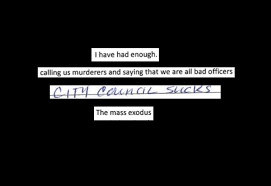
Copy of scathing response to exit inquiry

“There are lots of people walking out the door,” an officer explained. “This is a mass exodus. We’re losing people left and right. Why stick around when the City Council doesn’t appreciate you? [These officers are] fleeing the ‘Seattle mentality.’”

It is unlikely that a true mass exodus is taking place as some believe in the great Northwest. All large departments have officer turnover that can cause difficulty for recruiting efforts. In 2019, it has become more difficult to recruit men and women for the police service across the country. The Seattle story cites over three dozen officers who have left or are planning to leave the SPD because of feelings of unhappiness with the city. A true copy of one exit interview is shown above “New strategies will be essential to fill not only the recruitment gaps, but also the tremendous loss of organizational knowledge that will accompany the impending mass retirements. Few would argue that a department full of rookies at every level is what the profession needs, especially if those rookies are from a generation that craves immediate approval and recognition” as described in a paper published in Police Chief Magazine entitled A Crisis Facing Law Enforcement: Recruiting in the 21st Century.

According to Chief Sid Smith, “with the growing public concern over police use of deadly force, this mental health issue presents another challenge for the recruiters and places an added burden upon the mental health professionals retained to more carefully screen all applicants, including military veterans”. In a prior post the topic of protective factors for success in law enforcement are listed but a substantial factor impacting job satisfaction and career hardiness is perceived support from management and city government including members of city council and in some cases strong mayors. In 2014, the Seattle Police Department appointed Kathleen O’Toole, a former Boston Police Commissioner, to lead the agency which was under federal consent decree for cases of alleged excessive force. She resigned in 2017 for personal reasons.

Police officer vulnerability previously ignored, hidden from plain site

What is currently understood as repeated exposure to trauma and its emotional impact was once thought to be a testament to toughness invoking the specter of a wall of silence. Law enforcement and first responder suicide has increased over the past several years and now exceeds the number of LEO’s killed in the line of duty. Why are cops choosing to take their lives? This is especially felt in Chicago where seven officers have taken their own lives in the last 8 months. In more than one case an officer committed suicide in the police vehicle or in the police department parking lot.

My colleague Dr. Leo Polizoti, Police Consulting Psychologist at the Direct Decision Institute, Inc. has been active in law enforcement training, fitness, and prescreening for over 40 years. He served over 30 agencies across New England and provides supportive psychotherapy as needed.

Dr Polizoti and I were recently involved in a symposium on Police Suicide in Chicago sponsored by Daninger Solutions from Daytona Beach, Florida. Among the presenters were Dr Thomas Joiner from the University of Miami, recognized expert in suicide, police sergeant Mark Debona from Orlando, Florida and Dr Daniel Hollar, Chairman in department of Behavior Science at Berthune-Cookman University in Tallahassee, Florida and CEO at Daninger Solutions.

There are many reasons why police officers have an increased levels of depression and stress.  Most are associated with repeated exposure to traumatic events like exposure to dead bodies, violence, childhood injury or death, terrorism, fatal car crashes, and more.  Most officers are able to remain professionally hearty when provided the opportunity to defuse the exposure soon after an incident. Career performance should include reducing officer depression and embitterment by building resilience starting in the academy and lasting throughout an LEO’s career.

The Mind-Body connection is well established and the role of stress in LEO career well-being is becoming a agency focus beginning in the academy.

“Not only must we as negotiators learn to take care of ourselves emotionally and physically – we must also be prepared to intervene with an actively suicidal officer. “

Dave DeMarco FOX News Kansas City

Is it any wonder officers lose hope and resilience.  There are inherent risks that LEO’s assume when they sign on like forced overtime, changing shifts, off-duty court appearances, the chance they may become injured, disabled or killed while serving the community.  There are also systemic stressors like supervisory bullying, professional jealousy, lack of opportunity to have an impact on policy, career stagnation, and paramilitary chain of command that often devalues education and innovation.  Agencies are beginning to track exposure to trauma and its correlated change police officer resilience in real time.

In Worcester, Massachusetts, LEO’s are required to attend defusing sessions following high lethality/high acuity exposure.  These sessions are kept private from members of the command staff and records are saved by the police consulting psychologist. The department has nearly 500 officers who are paid for their participation when they attend. It has been proposed that officers undergo annual “wellness checks” as a routine in some agencies such as KCMO. I have proposed a system of tracking officer call acuity and invoking mandated behavioral health assessment after a specified number of high acuity/high lethality calls for service. This is one way of reducing the stigma that officers face when they are sent for “fitness” evaluation or any sort of behavioral health care. The stigma associated with mental health may be reduced by having specified referrals following identified high profile incidents. Officers may be considered to be getting peak performance training at these defusing sessions as they are designed for enhancing officer awareness and reducing the human stress response.

Now, the KCMO department has mandated yearly wellness exams for officers in certain units like homicide and those dealing with child abuse. This was initiated to decrease the impact of traumatic events on police officer well-being. Officers at KCMO can also get up to six free anonymous visits to a mental health clinician each year, and the department has a peer support team.  Mental health clinicians must have experience working with law enforcement officers for best results.  Training for clinicians should be provided to best work with LEO’s and first responders. This is especially true for officers who self-refer.  Clinical hours should be supervised by the police consulting psychologist.

Police Stress Intervention Continuum: An empirical option for LEO’s and command staff to reduce officer suicide

Scope of the Problem: Police Suicide and the goal to eliminate it – modified December 28, 2022
Police job-related stress is well-identified and reported in the media daily and the rates of suicide nationwide are being debated by Aamodt and Stalnaker. They are actually less than one is led to believe but even one law enforcement officer suicide is too much. During the week of Christmas 2022, 3 police officers took their own lives at Chicago PD. Some law enforcement officer deaths may be reduced by using a stress intervention continuum. This ties the continuum of calls into a stress reduction protocol that empowers resilience and recognizes the importance of stress mentoring and the soft hand-off for defusing the growing impact of high stress and high lethality exposure. The stress intervention continuum does not single out one officer but identifies all officers – including call takers, dispatchers, and supervisors for defusing particularly abhorrent events like mass shootings. This way, personnel who played a roll in a “bad call” will not be overlooked nor stigmatized for stress reduction defusing and/or debriefing.
Stress is defined as any situation that negatively impacts an officer’s well-being. The rate of suicide and divorce among law enforcement is approximately the same or lower than the general public according to a meta-analysis conducted by Professor Michael Aamodt.  But there are areas in the country and agencies that have higher rates of self-inflicted death.
When the suicide rate of police officers (18.1) is compared with the 21.89 rate for a comparable demographic population, it appears that police officers have a lower rate of suicide than the population according to Aamodt, 2008.
Incidence of suicide tend to be elevated in cities like Chicago, where chronic gun violence and a murder rate in the hundreds per year means cops see a staggering amount of traumatic events. As a result, they may gradually become numb to the exposure of pain and suffering (Joyner, 2009). A Department of Justice report found that the suicide rate in the Chicago Police Department is 60 percent higher than the national average.  According to the 2018 Chicago Sun Times, in a note to department members, former CPD Supt. Eddie Johnson said in 2018, “Death by suicide is clearly a problem in Law Enforcement and in the Chicago Police Department. We all have our breaking points, a time of weakness where we feel as if there is no way out, no alternative. But it does not have to end that way. You are NOT alone. Death by suicide is a problem that we can eliminate together” CST September 12, 2018.  Chicago PD is not alone with the problem of suicide among its men and women in blue. In fact, smaller departments with fewer than 50 officers often have high rates of suicide and lack the peer support and clinical resources that enable officers to find help during times of crisis.
Law enforcement officers (LEO’s) encounter the worst of all experience on a routine basis. The people who call the police may be society’s best upstanding citizens but on this occasion it could be the worst day of their lives and they seek help from police.  Many times it is not the pillars of society seeking help but those people in the fringes or margins of society now victims of violent crime or abuse.
According to Hartley, et.al., 2007, “repeated exposures to acute work stressors (e.g., violent criminal acts, sad and disturbing situations, and physically demanding responses), in addition to contending with negative life events (e.g., divorce, serious family or personal illness, and financial difficulties), can affect both the psychological and physiological well-being of the LEO population.” When these officers are identified there needs to be a planned response using a peer support infrastructure that provides for a continuum of service depending upon the individual needs of the LEO and the supports available. In many agencies, especially smaller departments lacking resources, officers’ languish and sometimes spiral downward without support and without somewhere to turn.  Police officers must have support available to them long before they are expressing suicidal urges.
As programs are identified and service continuum grows the risk of peer conflict over perceived betrayal of trust must be addressed. This must be addressed in the peer support training with emphasis on preservation of life over maintenance of confidentiality or the status quo of abject silence. “In itself, it’s a product of centuries of police culture in which perceived weakness is stigmatized. Cops know their brothers have their back, no matter what, but they still don’t want to be seen as the one who’s vulnerable.” according to a recent Men’s Health article written by Jack Crosbie in a report about suicide in the NYPD published during Mental Health Awareness month in May 2018.
The argument is made that the recurring uncertainty of police calls for service often leave LEO’s with low-level exposure to trauma of varying degrees. It is common that LEO’s move from one violent call to the next without time to decompress and process what they have seen.  The repeated exposure to trauma can slowly whittle away LEO resilience – defined as the capacity to bounce back from adversity. In a national media study published by Aamodt and Stalnaker, legal problems were a major reason for the law enforcement suicides yet no other study separately cited legal problems. In another study, relationship problems accounted for the highest percentage of suicides at 26.6% (relationship problems plus murder/suicide), followed by legal problems at 14.8%. In nearly a third of the suicides, no reason was known for LEO suicide.
Police suicide has been on the radar of advocates of LEO peer support for months or years.  The incidence of suicide has remained stable across the country but some agencies have higher rates of suicide.  Smaller departments – those with less than 50 officers in general have the highest rates of suicide.  This may be linked to the lack of availability of peer support programs and a paucity of local practitioners to provide professional service with knowledge in police psychology. “While police officers may adapt to the negative effects of chronic stress, acute traumatic incidents necessitate specialized mental health treatment for police officers (Patterson, 2001)”.  A referral to the department EAP often falls flat and makes it more difficult to make the hand-off when peer support is not enough.

Points of entry to Peer Support – Stress Intervention Continuum

  1. Exposure to highly stressful events in close sequence
  2. Change in work assignment, district/station, deployment undercover or return from deployment
  3. Increased absenteeism – over use of sick leave – missing court dates
  4. Increased use/abuse of substances – impacting job functioning, on-the-job injury
  5. Community – citizen complaint(s) for verbal abuse, dereliction of duty, vehicle crash
  6. Citizen complaints of excessive force during arrest, supervisory or peer conflict, or direct insubordination
  7. Abuse of power using baton, taser or firearm, recurrent officer involved use of force. Officers are sometimes strongly embittered and angry at this point in their career due to perceived lack of support and powerful feelings career disappointment and alienation – copyright Michael Sefton, Ph.D.
Real-time model of change
The use of force continuum is well described in the LEO literature and ongoing criminal justice narrative. What does that have to do with stress intervention in police officers? It sets the tone for officer behavior whenever they meet potential resistance and or increased aggression during citizen encounters. It may also be used for initiating peer support needs whenever an incident use of force has occurred.  LEO’s change the force response based on the situation they encounter in real-time in a flexible and fluid manner. In this same way, peer support programs can flexibly shift to the needs of a presenting LEO and intervene early on – rather than when an officer is at a breaking point. “This continuum (use of force) has many levels, and officers are instructed to respond with a level of force appropriate to the situation at hand, acknowledging that the officer may move from one point on the continuum to another in a matter of seconds.” NIJ publication.  Peer support too, must accommodate a law enforcement officer in real-time to begin the process of building a healthy, resilient response to sometimes horrific exposures and provide a continuum of unbiased employee assistance and when necessary professional consultation.
Protective Factors begin in Academy training
What topics should addressed while LEO recruits are in training?  Ostensibly, the resilience of LEO’s depends upon the opportunity for in-service training in topics of mindfulness, stress management, physical health maintenance, nutrition, and trust.
“Emotional resilience is defined as the capacity to integrate the breadth of police training and experience with healthy, adaptive coping, optimism, mental flexibility and healthy resolution of the traumatic events. In general, resilient people are self-reliant and have positive role models from whom they have learned to handle the stressful events all police officers encounter” according to Leo Polizoti, Ph.D. a police consulting psychologist (Sefton 2018).
Police programs for health maintenance
The Police Stress Intervention Continuum or P-SIC, involves a system of police support that varies in its intensity depending upon the continuum of individual needs of the LEO including physical debility or other significant components impacting career success and satisfaction. The intervention protocol is flexible and fluid as well. The entry point into the peer support continuum initiates from supervisory observations of LEO history and behavior, peer recommendations, and exposure to a range of traumatic events.
The cumulative stress associated with a career in law enforcement cannot be understated.  In the setting of police stress and stress support there is an intervention protocol that relates to the peer-support program continuum.  Depending on where officers enter the peer support network will impact the level of intervention they may require in the P-SIC program.  Peer support is not psychotherapy but officers occasionally must hand off the officer in trouble to a  higher level of care.  These hand-offs are key to linking at-risk LEO’s with range of professional support needed to keep them on the job. Yet fear of reprisal for acknowledging the cumulative impact of stress and its impact often derails the hand-off to the professional. The highest risk for suicide to a LEO is when he is denuded of badge and gun because he may be a threat to himself.
The career success they have may be directly related to the application of resiliency training to build and maintain physical and emotional hardiness that lasts a lifetime according to Leo Polizoti, 2018. Before this can happen the stigma associated with reaching out must be reduced.

NIJ Publication (2009). Use of Force Continuum. https://www.nij.gov/topics/law-enforcement/officer-safety/use-of-force/Pages/continuum.aspx. Taken November 17, 2018
Aamodt, M. G., & Stalnaker, N. A. (2001). Police officer suicide: Frequency and officer profiles. In Shehan, D. C, & Warren, J. I. (Eds.) Suicide and Law Enforcement. Washington, D.C.: Federal Bureau of Investigation.
Aamodt, M. (2008). Reducing Misconceptions and False Beliefs in Police and Criminal Psychology. Criminal Justice and Behavior 2008; 35; 1231 DOI: 10.1177/0093854808321527.
Patterson, G T. (200l). Reconceptualizing traumatic incidents experienced by law enforcement personnel. The Australian Journal of Disaster and Trauma Studies, 2.
Joyner, T. (2009) The Interpersonal-Psychological Theory of Suicidal Behavior: Current Empirical Status. Science Briefs, American Psychological Association, June.
Sefton, M. (2018). Police Training: Revisiting Resilience Blog post: https://msefton.wordpress.com/2018/07/27/police-training-revisiting-resilience/. Taken November 18, 2018
Sefton, M. (2018) Points of Entry to Peer Support and mentoring. Blog post: https://wordpress.com/post/msefton.blog/5269 – taken December 27, 2022
Hartley, T., et.al.(2007). Associations Between Major Life Events, Traumatic Incidents, and Depression Among Buffalo Police Officers. International Journal of Emergency Mental Health, Vol. 9, No. 1, pp.
John M. Violanti, Anna Mnatsakanova, Tara A. Hartley, Michael E. Andrew, Cecil M. Burchfiel. (2012). Police Suicide in Small Departments: A comparative analysis. Int J Emerg Ment Health. Published in final edited form as: Int J Emerg Ment Health. 2012; 14(3): 157–162.